





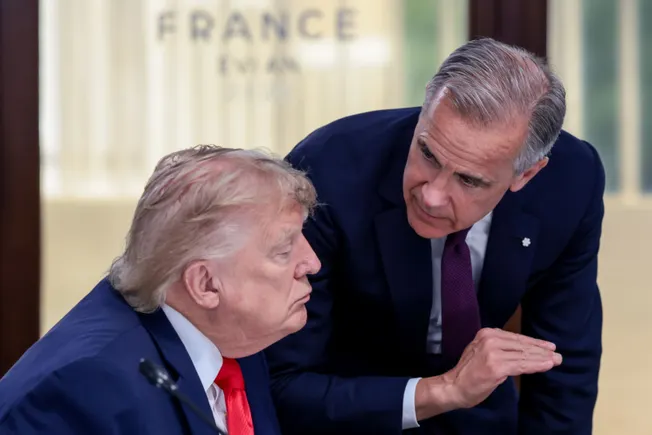
The fragile state of North American trade was thrust into a period of acute uncertainty this Friday as negotiations between the United States and Canada collapsed. The breakdown of talks, aimed at averting a punitive 50% tariff regime on $20 billion worth of Canadian imports, marks a dramatic escalation in regional protectionism. With both nations now retreating to confrontational postures, the future of the interconnected supply chains that define the economies of the U.S. and its northern neighbor remains in serious jeopardy.
The Immediate Crisis: A Breakdown in Diplomacy
The failure to reach an agreement comes at the end of a month of high-stakes, behind-the-scenes diplomacy. Following President Donald Trump’s executive order imposing 50% tariffs on a massive swath of Canadian goods—ranging from raw agricultural commodities and chemicals to finished consumer goods, textiles, and heavy machinery—the two nations had been locked in a race against time.
The impasse reached its climax on Friday evening when Canadian Prime Minister Mark Carney issued a formal statement announcing the suspension of all trade negotiations. "In recent weeks, we made important progress toward improving Canada’s position as having the best deal in the world with the U.S.," Carney stated. "However, that progress has not been enough to meet our objectives for Canadians. As a result, this evening, I have decided to suspend trade negotiations with the U.S. and have directed Canada’s negotiators to return to Ottawa."
The Canadian Prime Minister cited "last-minute changes" proposed by the U.S. delegation, which he characterized as "unfair, uneconomic, and [a factor that] called into question the reliability of any deal."
Chronology of a Deteriorating Relationship
The current standoff is not an isolated event but the culmination of a deteriorating bilateral environment that has been building throughout the year.
- Early Summer 2026: Tensions flared when the United States officially declined to extend the trilateral United States-Mexico-Canada Agreement (USMCA), effectively triggering an up-to-10-year annual review process. This move signaled a shift in U.S. trade policy toward more aggressive, transactional negotiations.
- The Tariff Order: Last month, President Trump issued a mandate for 50% tariffs on $20 billion of Canadian imports. This move was framed by the White House as a necessary correction to trade imbalances and a leverage tool to force a renegotiation of specific sectoral terms.
- The Negotiation Window: Over the past four weeks, both nations engaged in intense talks. While the U.S. reached formal bilateral understandings with Mexico, the U.S.-Canada track remained fraught with friction.
- The Friday Collapse: Following a final round of talks, the U.S. accused Canada of "walking back" previous commitments. Simultaneously, Canada accused the U.S. of introducing bad-faith amendments at the eleventh hour. The subsequent breakdown triggered the automatic activation of the 50% tariffs, which had been previously delayed.
Supporting Data: The Scope of the Trade War
The economic stakes of this dispute are immense. The $20 billion in imports targeted by the U.S. tariffs touch virtually every sector of the industrial economy. By slapping a 50% levy on these goods, the U.S. is effectively attempting to decouple significant portions of its manufacturing supply chain from Canadian inputs.
Targeted Sectors Include:
- Raw Materials: Wood products, paper, and pulp.
- Industrial Inputs: Chemicals, fertilizers, and raw minerals.
- Energy and Agriculture: Various raw agricultural commodities that serve as the backbone for U.S. food processing.
- Manufacturing: Tools, machinery, and automotive components that cross the border multiple times before a vehicle is finalized.
Canada, for its part, has signaled that it will not absorb these costs passively. Prime Minister Carney has pledged to "match those tariffs dollar for dollar," signaling a return to the tit-for-tat retaliatory cycle that defined the previous era of trade wars. Historically, Canada has utilized targeted tariffs on U.S. steel, aluminum, and finished automotive products to exert political pressure on specific U.S. legislative districts.
Official Responses and Political Rhetoric
The blame game following the collapse has been swift and severe. The Office of the U.S. Trade Representative (USTR) took to social media to express frustration, explicitly blaming the Canadian government for the failure to secure a deal.
"Despite the U.S. offer to Canada to receive the best treatment of any major exporter to our market, new demands and walk backs of other commitments by Canada have upended the careful balance reached in the past days," the USTR stated via their official communication channels. The U.S. emphasized that it had proposed "significant tariff reductions" in exchange for Canadian concessions on steel, aluminum, and lumber—sectors that have long been lightning rods for bilateral friction.
Canada’s perspective remains that the U.S. demands were fundamentally incompatible with national economic interests. By characterizing the U.S. proposals as "uneconomic," the Canadian administration is signaling to its domestic stakeholders that the terms offered would have resulted in long-term structural damage to the Canadian manufacturing base.
Implications for North American Trade and Industry
The implications of this standoff extend far beyond the immediate financial impact of the tariffs. Industry experts and analysts are warning that the breakdown threatens the very foundation of the North American economic bloc.
1. The Uncertainty Premium
For global corporations operating in North America, the primary concern is the death of predictability. Business investment relies on stable trade rules. When the "rules of the game" change monthly, companies are forced to hold back on capital expenditure, reduce inventory, or seek alternative, albeit more expensive, supply chain routes outside the continent.
2. Integration vs. Isolation
As noted by Pete Mento, managing director of global trade advisory services at Baker Tilly, the two economies are "simply too integrated" for this level of escalation to be sustainable. The cross-border flow of intermediate goods—where a product is partially manufactured in Canada, shipped to the U.S. for finishing, and then returned to Canada for final assembly—means that a 50% tariff is effectively a tax on domestic production.
3. The Future of the USMCA
The breakdown significantly complicates the ongoing review of the USMCA. With the U.S. having already established a separate track with Mexico, there is a risk that North American trade will fracture into a "hub-and-spoke" model, where the U.S. negotiates with neighbors individually rather than as a trilateral unit. This weakens the collective bargaining power of the continent in the face of competition from Asia and Europe.
Looking Ahead: Is a Settlement Possible?
While the rhetoric is currently hostile, analysts suggest that the economic pain of these tariffs will eventually force both sides back to the table. The "real question," according to Mento, is not whether the tariffs will be lifted, but whether the eventual settlement can restore confidence in the governing rules of trade.
For now, businesses must prepare for a period of high costs and logistical friction. As supply chains scramble to reroute and procurement managers deal with the inflationary impact of the 50% levies, the political temperature in Ottawa and Washington remains at an all-time high. Whether this is a tactical maneuver by both sides to gain leverage in a final deal, or a fundamental shift in the North American trade paradigm, remains to be seen. One thing is certain: the era of frictionless, integrated North American commerce is currently on hold.
