




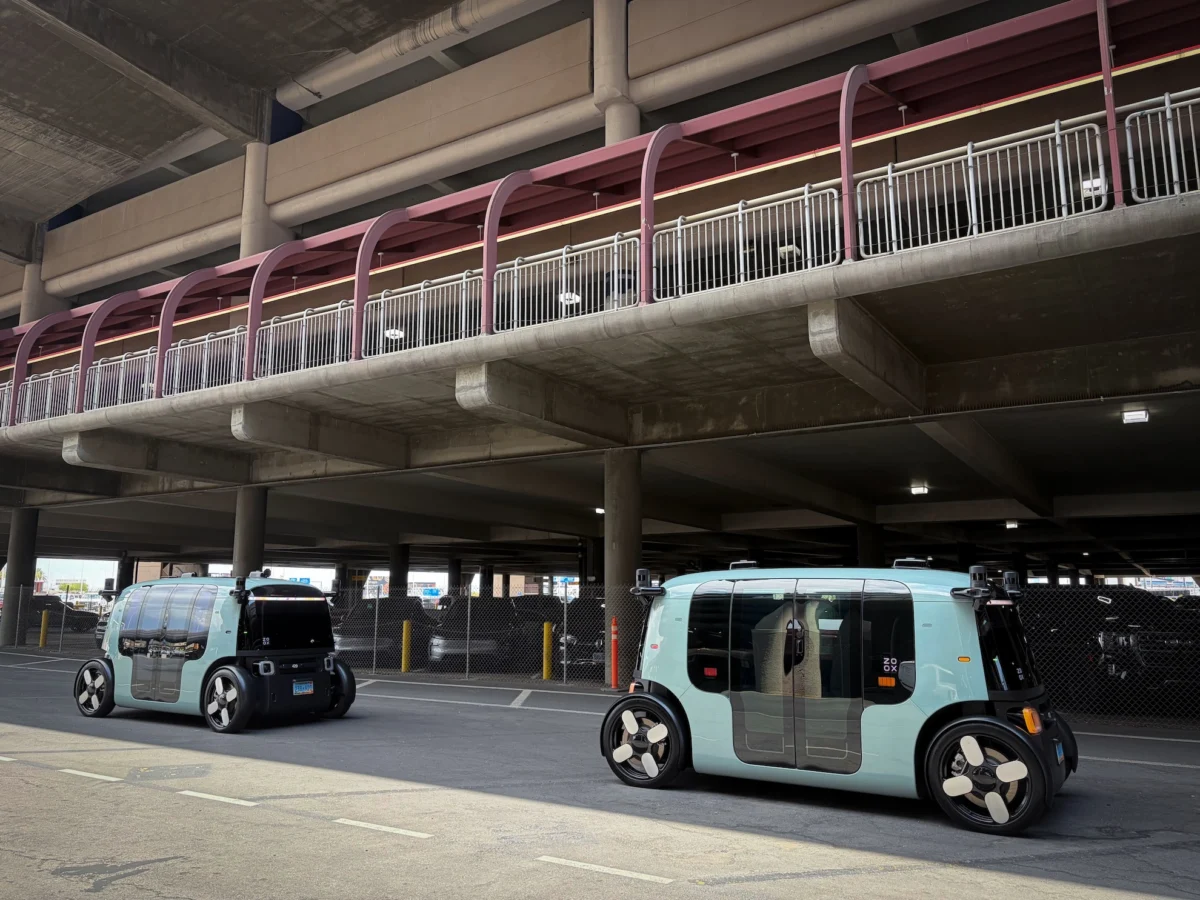
LAS VEGAS — Amazon-owned autonomous vehicle pioneer Zoox has announced a major expansion of its commercial operations, launching robotaxi service to and from Harry Reid International Airport (LAS). Beginning Thursday, passengers in Las Vegas will be able to hail Zoox’s custom-built, steering-wheel-free autonomous vehicles for airport transit.
This expansion marks a critical milestone for the Silicon Valley-based company. By securing access to one of the busiest airport corridors in the United States, Zoox is positioning itself at the forefront of the commercial autonomous vehicle (AV) race, unlocking a highly lucrative transit market and intensifying competition with traditional ride-hailing giants and rival AV developers.
Main Facts: The Las Vegas Airport Expansion
The newly announced service allows public passengers to book rides directly to and from Harry Reid International Airport using Zoox’s proprietary ride-hailing app. The service is not merely a pilot program; it is a fully commercial, paid offering made possible by recent regulatory clearances.
Terminal Access and the Competitive Edge
A key highlight of Zoox’s airport service is its physical pick-up and drop-off locations. According to the company, its robotaxis will operate directly at both airport terminals, picking up and dropping off passengers near the baggage claim areas.
This terminal-adjacent access provides Zoox with a significant competitive advantage over traditional ride-hailing giants Uber and Lyft. While Uber and Lyft drivers are permitted to drop passengers off at the terminal curbside, their designated pick-up zones require passengers to walk five to ten minutes, navigating escalators and pedestrian bridges to reach the upper floors of nearby parking structures. By offering curbside pick-up directly outside baggage claim, Zoox eliminates a major pain point for travelers carrying heavy luggage.
The Vehicle: A Purpose-Built Carriage
Unlike its competitors, which typically retrofit production vehicles with self-driving sensors, Zoox utilizes a bespoke, "purpose-built" vehicle.
- Design: The carriage-style cabin features symmetrical, face-to-face seating for up to four passengers.
- Controls: The vehicle is completely devoid of traditional manual controls, containing no steering wheel, accelerator pedal, or brake pedal.
- Capabilities: It features four-wheel steering and bidirectional driving capabilities, allowing it to navigate tight airport terminal loops and reverse direction without needing to turn around.
Chronology: A Decade-Long Journey to Paid Passenger Rides
The launch of the airport service is the culmination of more than ten years of research, development, and regulatory negotiations.
[2014] Zoox Founded in Silicon Valley
  │
  ├── [June 2020] Acquired by Amazon for $1.2 Billion
  │
  ├── [Early 2023] First Public Road Tests of Custom Robotaxi (Las Vegas Employee Shuttle)
  │
  ├── [July 30, 2026] Secures Crucial NHTSA Temporary Safety Exemption
  │
  ├── [August 10, 2026] Launches Paid Commercial Service in Las Vegas
  │
  └── [September 2026] Expands to Harry Reid International Airport & Announces San Diego/Houston Testing
The Early Years and Amazon Acquisition (2014–2020)
Founded in 2014, Zoox operated with a contrarian philosophy. While contemporary AV startups focused on writing software to retrofit existing cars, Zoox set out to build both the autonomous driving stack and an entirely new category of vehicle from scratch.
In June 2020, Amazon acquired Zoox in a deal valued at approximately $1.2 billion, providing the financial runway and logistics expertise needed to transition the company from an ambitious R&D project into a commercial enterprise.
Testing and Incremental Deployment (2021–2025)
Zoox spent years testing its technology in San Francisco, Seattle, Foster City, and Las Vegas. In early 2023, the company achieved a historic milestone by operating its custom robotaxi on open public roads in Nevada, initially serving as an employee shuttle. For over a year, Zoox refined its operations in the complex driving environment of the Las Vegas Strip, though it was legally restricted from charging the general public for rides.
The Summer of 2026: The Commercial Breakthrough
The regulatory logjam broke in mid-2026:
- July 30, 2026: The National Highway Traffic Safety Administration (NHTSA) granted Zoox a critical temporary exemption from several Federal Motor Vehicle Safety Standards (FMVSS).
- August 10, 2026: Armed with federal clearance, Zoox officially launched its paid commercial robotaxi service in Las Vegas.
- Late August to September 2026: Bolstered by commercial success, Zoox announced plans to expand testing to San Diego and Houston, released its comprehensive safety framework, and finalized plans for the Harry Reid International Airport expansion.
Supporting Data: The Regulatory Framework and Market Metrics
The expansion of autonomous ride-hailing in Clark County, Nevada, is governed by a strict matrix of federal and state regulations, which have recently shifted to accommodate rapid commercial scaling.
The NHTSA Exemption Metrics
Zoox’s commercial viability hinges on the two-year temporary exemption granted by the NHTSA. Because the vehicle lacks a steering wheel, pedals, and traditional mirrors, it cannot comply with standard FMVSS rules designed for human-driven cars.
| Regulatory Parameter | Exemption Details |
|---|---|
| Duration of Exemption | 2 Years (Active through mid-2028) |
| Fleet Cap under Exemption | Up to 2,500 active vehicles nationwide |
| Exempted Safety Standards | 8 federal standards (including windshield defrosting, light vehicle braking systems, and manual control placement) |
| Reporting Requirements | Mandatory, real-time crash and incident reporting to federal regulators |
The Nevada Competitive Landscape
While Zoox has secured an early mover advantage at the airport, the broader Las Vegas market is preparing for an influx of autonomous competitors. In August 2026, the Nevada Transportation Authority (NTA) issued commercial operating permits to three major players: Tesla, Uber, and Waymo (Alphabet’s self-driving unit).

These state permits authorize a massive influx of driverless vehicles into Clark County:
- Total Permitted Fleet Size: Up to 8,000 commercial robotaxis across all operators over the next 12 months.
- Inter-Company Partnerships: Uber is pursuing a multi-pronged approach, partnering with both Hyundai’s autonomous joint venture, Motional, and Zoox itself to integrate driverless rides directly into the Uber app ecosystem in the future.
Official Responses and Strategic Alignment
The expansion has drawn praise from company executives, who view the airport corridor as the ultimate proof-of-concept for urban autonomous mobility.
Zoox Executive Strategy
In statements accompanying the rollout, Zoox leadership emphasized that the airport expansion represents the realization of the company’s founding vision: solving the most complex and high-demand transit routes in urban environments.
"Unlocking Harry Reid International Airport is a watershed moment for Zoox," said a company spokesperson. "Airport travelers represent a demographic that highly values convenience, efficiency, and safety. By delivering passengers directly to terminal baggage claims—bypassing the long walks associated with traditional ride-hailing apps—we are demonstrating the unique consumer value that a purpose-built, driverless vehicle can offer."
The company also highlighted the release of its updated safety framework, designed to assure local authorities and passengers of the system’s multi-layered redundancies, which include 360-degree camera, radar, and LiDAR coverage, alongside remote guidance capabilities to assist vehicles in unpredictable scenarios.
Industry and Municipal Reaction
Local tourism and transportation officials in Las Vegas have welcomed the technology, viewing AVs as a viable solution to ease traffic congestion along the packed Las Vegas Boulevard corridor.
Industry analysts note that Amazon’s long-term backing gives Zoox a unique cushion. "Unlike independent AV startups that face immediate pressure to monetize, Zoox has the luxury of Amazon’s capital," noted Roger Lanctot, an automotive technology analyst. "This allows them to focus intensely on the passenger experience and safety, which is clear in how they’ve secured premium real estate at the Las Vegas airport terminals."
Implications: Redefining Airport Transit and the Future of AVs
The introduction of Zoox’s commercial service at Harry Reid International Airport has far-reaching implications for the transportation industry, urban planning, and the broader tech economy.
Disruption of the Airport Transit Economy
Airport transfers are among the most profitable segments for traditional ride-hailing platforms and municipal taxi fleets. In Las Vegas, where millions of tourists arrive weekly, the corridor connecting the airport to the Strip represents a highly concentrated revenue stream.
By eliminating the "parking garage hike" for passengers, Zoox is directly targeting the convenience factor that drives consumer choices. If Zoox can maintain competitive pricing while offering superior terminal proximity, it could siphon a significant portion of high-margin airport business away from Uber, Lyft, and local taxi companies.
The Purpose-Built vs. Retrofit Debate
The AV industry remains divided on vehicle architecture:
- The Retrofit Approach (Waymo, Motional): Utilizing standard production vehicles (such as the Jaguar I-Pace or Hyundai Ioniq 5) outfitted with sensor suites. This approach is faster to scale initially because the underlying vehicles are already mass-produced and crash-tested.
- The Purpose-Built Approach (Zoox, Tesla’s proposed Cybercab): Designing vehicles from the ground up without steering wheels or pedals. While much harder to clear regulatory hurdles, this approach optimizes interior space, comfort, and operational efficiency (such as bidirectional driving).
Zoox’s successful deployment of its steering-wheel-free carriage at a major international airport serves as a powerful validation of the purpose-built philosophy, proving that unconventional vehicle designs can operate safely and legally in highly regulated, high-density environments.
Regulatory Precedents and Future Scaling
The two-year NHTSA exemption granted to Zoox will serve as a crucial test case for federal regulators. The data collected from Zoox’s 2,500-vehicle fleet will likely shape future federal legislation regarding autonomous vehicle standards. If Zoox maintains an exemplary safety record over the next two years, it will pave the way for permanent regulatory frameworks that accommodate vehicles built without human controls, fundamentally altering the future of automotive design and urban transit.
