A trip to any major European city often requires adjusting to a culture of walking, cycling, and robust public transit. Yet, despite these dense pedestrian networks, cars remain the default choice for urban mobility. For many city dwellers, the decision to stick with four wheels comes down to a simple, practical limitation: carrying capacity. While bicycles and traditional scooters are nimble, they fail when it comes to grocery runs, weekend getaways, or transporting professional gear.
Belgian startup Any is seeking to challenge this status quo. Founded on the belief that urban two-wheelers must be "designed for real life," the company has unveiled its flagship product: the LUV1 (Life Utility Vehicle 1). By combining the cargo capacity of an electric cargo bike with the speed, range, and build quality of a light motorcycle, Any hopes to pioneer an entirely new category of urban transport.
Main Facts: Redefining Two-Wheeled Utility with the LUV1
At the core of Any’s mission is the acknowledgment of a market gap left unfilled by current micro-mobility options. While electric cargo bikes have surged in popularity, they are structurally limited by low speed thresholds (typically capped at 25 km/h or 15.5 mph in Europe) and are restricted from main roadways. Conversely, standard electric motorcycles offer high speeds but almost zero cargo storage.
+-----------------------------------------------------------------------------+
|                           THE LUV1 AT A GLANCE                              |
+----------------------+------------------------------------------------------+
| Category             | Life Utility Vehicle (LUV) / Light Electric Vehicle  |
| Top Speed            | 100 km/h (62 mph)                                    |
| Cargo Capacity       | Up to 120 Liters (Modular Configurable)              |
| Range                | Up to 87 miles (140 km) via dual swappable batteries |
| License Required     | A1 License (Accessible across Europe)                |
| Base Price           | €7,000 (Approx. $8,150 USD)                          |
+----------------------+------------------------------------------------------+
The LUV1 aims to bridge this divide. Classified as a light electric motorcycle, the vehicle features a modular design capable of holding up to 120 liters of cargo—a volume comparable to a small car trunk. Despite this hauling capacity, the LUV1 can reach a top speed of 100 km/h (62 mph), making it equally viable for congested city centers and fast-moving suburban arterial roads.
A Design Pedigree from Pininfarina
To elevate the vehicle beyond a utilitarian box on wheels, Any partnered with Lowie Vermeersch, the former design director at the legendary Italian car design firm Pininfarina. Vermeersch, who also founded the creative consultancy Granstudio, did not just design the LUV1; he joined Any as its creative director and became one of its primary investors.
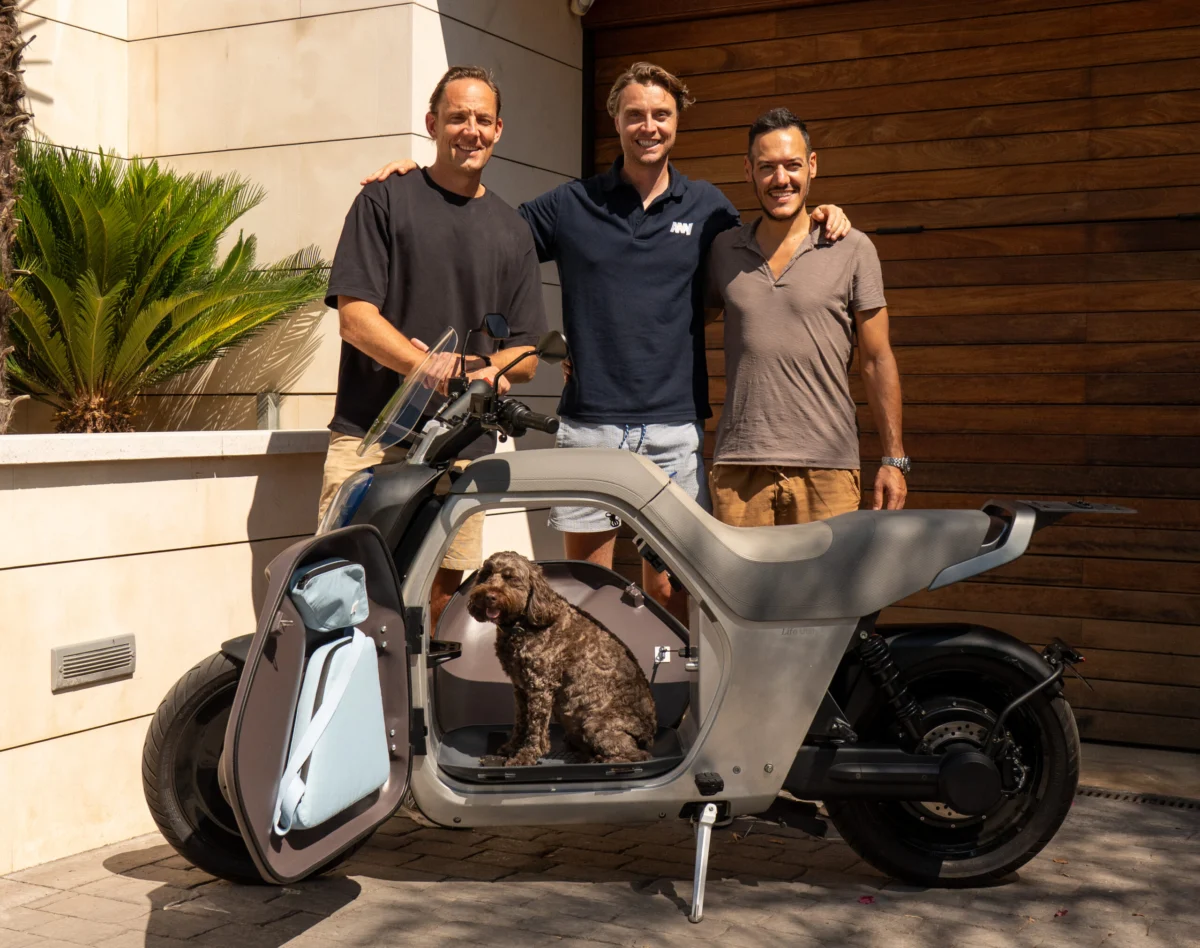
Under Vermeersch’s direction, the LUV1 was designed with modularity at its core. Customers can choose between an open-frame design or select from a variety of side panels tailored for specific use cases—whether that involves transporting pets, carrying specialized work tools, or packing camping gear. Additional accessories include an optional windshield, heavy-duty racks, an integrated rain poncho, and specialized luggage compartments.
Chronology: From Blueprint to Series A Campaign
The development of Any and the LUV1 represents a rapid progression from a design concept to a venture-backed manufacturing endeavor.
  Nov 2024          May 2025          Aug 2025          Late 2025
     │                 │                 │                 │
     ▼                 ▼                 ▼                 ▼
Seed Round        Milan Debut       600 Preorders      Series A
(€1.5M raised)    (€1.25M top-up)   in 100 Days       (€10M target)
Phase 1: Foundation and Early Funding (Late 2024)
Any quietly built its executive team, recruiting seasoned professionals from both the micro-mobility and automotive sectors. In November 2024, the startup closed an initial seed funding round of €1.5 million to finance early prototyping and engineering validation. During this phase, the startup recruited Pieter Van de Velde, a former venture capitalist, to serve as Chief Executive Officer, alongside co-founder and Chief Commercial Officer Erik de Winter, who previously co-founded the successful Dutch e-cargo bike-sharing platform Cargaroo.
Phase 2: The Milan Reveal and Financial Top-Up (May 2025)
The startup stepped into the international spotlight in May 2025 at Milan Design Week. The eye-catching prototype of the LUV1, alongside a companion concept called the Blacksheep One, received widespread critical acclaim from design and transport publications. Leveraging this public momentum, Any secured a €1.25 million top-up to its seed round, bringing its total early-stage funding to €2.75 million ($3.2 million).
Phase 3: Launch of the Configurator and Pre-order Success (Summer 2025)
Following the Milan debut, Any launched an online digital configurator allowing prospective buyers to customize their LUV1 frames, panels, and accessories. To secure a build slot, customers were asked to place a fully refundable €49 ($57) reservation fee. CCO Erik de Winter confirmed that within the first 100 days of the configurator going live, Any secured more than 600 active reservations.
Phase 4: Scaling Up for Production (Present)
Having validated market demand, Any is currently transitioning from prototyping to assembly-line preparation. To finance the setup of its supply chain, tooling, and initial production runs, the startup is actively raising a Series A funding round of €10 million ($11.65 million) or more, with the goal of closing the round by the end of the current calendar year.
Supporting Data: Technical Specifications and Market Positioning
To understand how the LUV1 fits into the broader transport landscape, it is helpful to analyze its technical specs and pricing relative to its closest competitors: electric cargo bikes and full-sized electric cars.
+---------------------+-------------------+---------------------+-------------------+
| Metric              | E-Cargo Bike      | Any LUV1            | Compact Electric  |
|                     | (e.g., Urban Arrow)|                     | Car (e.g., Ami)   |
+---------------------+-------------------+---------------------+-------------------+
| Base Price          | €5,000 - €8,000   | €7,000              | €8,000 - €12,000  |
| Top Speed           | 25 km/h (15.5 mph)| 100 km/h (62 mph)   | 45 km/h (28 mph)  |
| Cargo Capacity      | ~150 - 250 Liters | 120 Liters          | ~60 - 150 Liters  |
| Licensing           | None Required     | A1 License          | AM License / None |
| Footprint           | Small (Bike Lane) | Small (Road/Parking)| Medium (Road)     |
+---------------------+-------------------+---------------------+-------------------+
Power, Range, and Licensing
The LUV1’s performance is powered by two swappable batteries that deliver a combined range of up to 87 miles (140 km) on a single charge. Swappable battery architecture is highly advantageous for urban riders who lack access to dedicated garage charging infrastructure, as the batteries can be removed and charged indoors using standard household outlets.
Furthermore, Any strategically engineered the LUV1 to comply with the A1 motorcycle license category in Europe. The A1 license is highly accessible:
It can be obtained by individuals as young as 16 or 18 in most European jurisdictions.
In several countries, including France, Spain, and Belgium, drivers with a standard Class B (car) license can operate A1-class vehicles after completing a brief, practical training course without undergoing a full motorcycle licensing exam.
This regulatory positioning significantly lowers the barrier to entry for car drivers looking to downsize their daily transport.
Official Responses: The Philosophy Behind "Design for Real Life"
Any’s corporate communication emphasizes that the LUV1 was designed in response to real-world consumer behavior rather than theoretical urban planning models. In a detailed statement published on LinkedIn, the startup explained the origin of the vehicle’s generous cargo capacity:
"It came from asking a simple question: what does a real week actually need? Groceries, weekend bags, suitcases… the stuff you don’t want to leave behind just because you’re on two wheels, not four. 120 liters wasn’t a number we picked to sound impressive; it was the volume required to make the LUV1 a true car replacement."
Executive and Engineering Vision
The company’s leadership believes that to convert traditional car drivers, they must offer automotive-grade reliability and performance. This philosophy guided the recruitment of Alessandro Mangano as Head of Engineering. Mangano’s resume includes engineering roles at prestigious automotive and motorcycle brands, including Aprilia, Ferrari, and the Piaggio Group.
Speaking to TechCrunch, CCO Erik de Winter emphasized that the LUV1’s market appeal stretches far beyond typical motorcycle enthusiasts:
"We are targeting a customer base that goes beyond traditional motorcycle riders. We see interest from daily commuters, families, and outdoor enthusiasts who want utility without the burden of a car. Additionally, we have been approached by last-mile delivery players who require fast, high-capacity vehicles to navigate congested city centers."
De Winter also revealed that the LUV1 is only the first step in a broader roadmap. The startup intends to develop a comprehensive "portfolio of vehicles," which could eventually include a heavy-duty three-wheeled variant designed specifically for commercial logistics and cargo operations.
Implications: Disrupting Urban Mobility and Last-Mile Logistics
The arrival of the LUV1 comes at a critical juncture for European urban planning. Dozens of major cities are implementing Low Emission Zones (LEZs) and Zero Emission Zones (ZEZs), which restrict or heavily tax internal combustion engine (ICE) passenger cars. As cities reclaim street space from cars to build bike lanes and pedestrian zones, parking is becoming increasingly scarce and expensive.
Bridging the Speed and Utility Gap
Historically, consumers wanting to transition away from cars faced a stark choice:
The Bicycle/E-Bike Route: Environmentally friendly and cheap, but slow, exposed to weather, and geographically limited to short distances.
The Scooter/Motorcycle Route: Fast and agile, but highly limited in utility, making grocery shopping or carrying luggage difficult.
By establishing the "Life Utility Vehicle" category, Any offers a middle path. The LUV1 provides the speed necessary to utilize commuter highways while maintaining the small physical footprint and parking ease of a two-wheeler.
Accelerating Last-Mile Delivery Decarbonization
The commercial delivery sector is under immense pressure to decarbonize. E-commerce growth has flooded city centers with delivery vans, contributing to traffic gridlock and localized air pollution.
For logistics giants (such as DHL, DPD, and Amazon), a vehicle like the LUV1 represents a significant operational optimization. It can travel at highway speeds from suburban sorting hubs directly into city centers, and then navigate narrow streets and park on sidewalks like a scooter, all while carrying substantial payload volumes.
The Road Ahead: Hardware Scale-Up Challenges
While the initial reception and 600+ pre-orders demonstrate clear market interest, Any faces the formidable challenge of scaling hardware production. Manufacturing vehicles is notoriously capital-intensive. Setting up supply chains, securing regulatory type-approvals, and establishing a distribution and service network will test the startup’s operational capabilities.
The success of its upcoming €10 million Series A round will ultimately determine whether the LUV1 remains a celebrated design prototype or becomes a common sight on European streets. If Any can successfully scale, the LUV1 may well serve as the blueprint for the next evolution of urban transit—proving that to get people out of cars, you don’t have to ask them to leave their lives behind.