



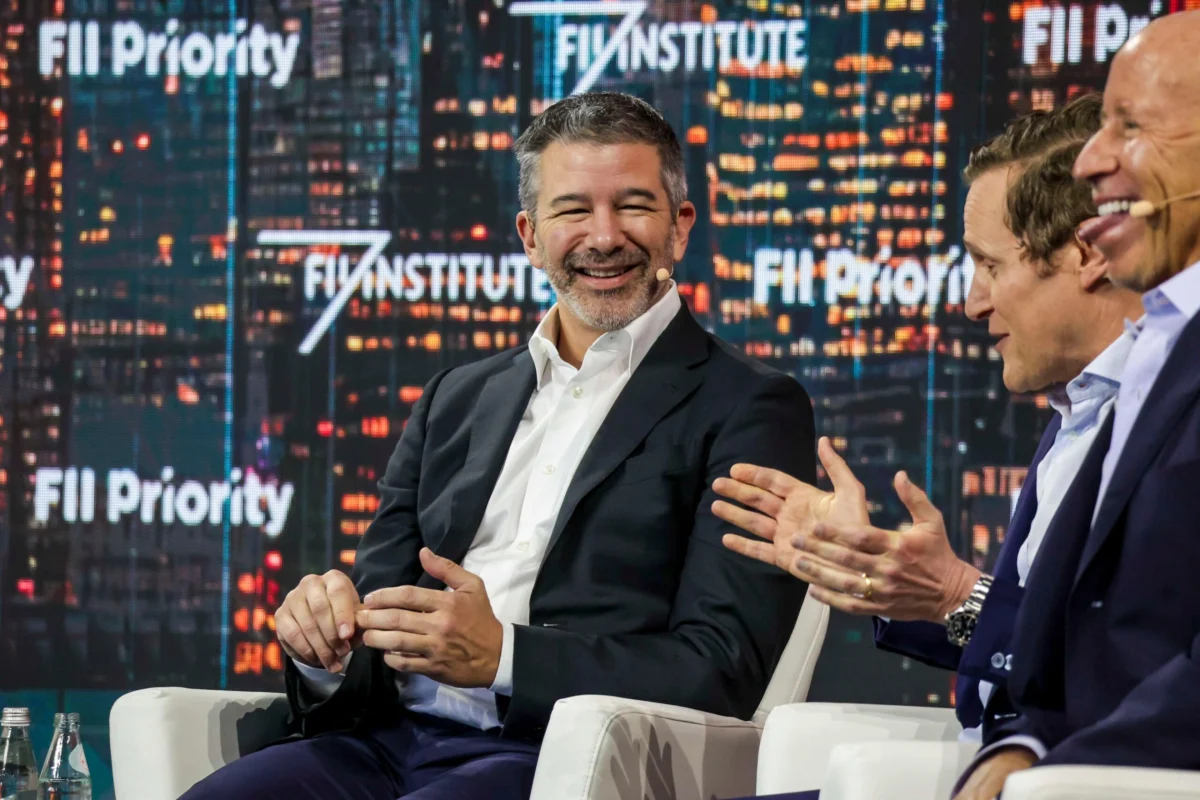
SAN FRANCISCO — Nearly a decade after his tumultuous departure from Uber, Travis Kalanick is positioning himself for a dramatic return to the center of the autonomous vehicle (AV) revolution.
Earlier this summer, Kalanick’s secretive robotics startup, Atoms, made headlines by securing a massive $1.7 billion funding round led by the prominent venture capital firm Andreessen Horowitz (a16z). While the company initially kept its precise commercial ambitions under wraps, new details have emerged indicating that Atoms is preparing for an aggressive expansion into the autonomous vehicle and robotaxi markets.
According to a report by the Financial Times, Atoms is gearing up for a major hiring spree and a series of strategic acquisitions designed to transform the startup into a dominant force in the self-driving sector. Furthermore, the startup has already held preliminary discussions with Uber about integrating Atoms’ self-driving technology into the ride-hailing giant’s global network—a development that represents a remarkable full-circle moment for both Kalanick and the company he co-founded.
1. Main Facts: The Atoms War Chest and the Return of Kalanick
Atoms’ recent activities signal a highly capitalized, multi-pronged effort to disrupt the current autonomous vehicle landscape, which is currently dominated by Alphabet’s Waymo, General Motors’ Cruise, and Amazon’s Zoox.
The core elements of Atoms’ current strategy include:
- The Mega-Round: Atoms raised $1.7 billion in a funding round led by Andreessen Horowitz, providing the startup with the financial runway required to compete in the capital-intensive AV sector.
- The Uber Connection: Uber has made a strategic $100 million investment in Atoms. This financial tie is accompanied by early-stage talks regarding how Uber could utilize Atoms’ proprietary robotaxi technology on its ride-sharing platform.
- Executive Talent: To manage its war chest, Atoms recently recruited former Uber finance chief Nelson Chai to serve as its Chief Financial Officer (CFO), bringing seasoned ride-hailing financial expertise to the executive team.
- The Pronto Acquisition: Atoms has acquired Pronto, an autonomous mining and off-road driving startup. Pronto was founded by Anthony Levandowski, the controversial self-driving pioneer who previously headed Uber’s autonomous vehicle division.
- Aggressive Expansion: Insiders report that Atoms is planning a massive recruitment drive, targeting top-tier engineering talent from rival AV firms, alongside pursuing further corporate acquisitions to consolidate its technological stack.
While sources close to the company emphasize that robotaxis are not the only focus of Atoms’ broader robotics portfolio, the convergence of self-driving technology, ride-hailing partnerships, and key historical figures suggests that the AV market is a primary pillar of Kalanick’s vision.
2. Chronology: From Uber’s Fall to Atoms’ Rise
To understand the significance of Atoms’ emergence, it is necessary to trace the decade-long timeline of legal battles, executive ousters, and corporate pivots that led to this moment.
[2017] ── Kalanick ousted from Uber; Waymo sues Uber over Anthony Levandowski's alleged trade secret theft.
  │
[2018] ── Kalanick launches City Storage Systems (CloudKitchens); Levandowski founds autonomous startup Pronto.
  │
[2020] ── Levandowski sentenced to 18 months in prison; Uber sells its ATG self-driving unit to Aurora.
  │
[2021] ── Levandowski receives a presidential pardon; Kalanick quietly expands his focus into industrial robotics.
  │
[July 2026] ── Atoms raises $1.7 billion in a funding round led by Andreessen Horowitz.
  │
[August 2026] ─ Atoms hires former Uber CFO Nelson Chai; Uber's $100 million investment in Atoms is confirmed.
  │
[September 2026] ─ FT reports Atoms is planning AV acquisitions and has held robotaxi integration talks with Uber.
The Origins of the Rift (2017–2020)
In 2017, Travis Kalanick was forced out as CEO of Uber following pressure from benchmark investors amid corporate culture scandals. Coinciding with his departure, Uber was embroiled in a high-profile lawsuit filed by Waymo, which accused Uber of stealing trade secrets via Anthony Levandowski, who had joined Uber after selling his self-driving truck startup, Otto, to the ride-hailing giant.
The legal fallout was severe. Uber eventually settled with Waymo for $245 million in equity, shut down its internal lidar development program, and eventually sold its Advanced Technologies Group (ATG) to Aurora Innovation in late 2020. Levandowski was criminally prosecuted, pleaded guilty to one count of trade secret theft, and was sentenced to 18 months in prison in August 2020. He was later pardoned by President Donald Trump in January 2021.
The Stealth Era (2021–2025)
Following his departure from Uber, Kalanick focused on City Storage Systems, the parent company of CloudKitchens, a startup focused on ghost kitchens for food delivery. However, Kalanick’s interest in automation and robotics never waned. Under the umbrella of his investment fund, 10100, and various stealth entities, Kalanick began quietly acquiring robotics assets, culminating in the creation of Atoms.

The Re-emergence (2026)
In July 2026, Atoms stepped out of the shadows with its massive $1.7 billion funding announcement. Within weeks, the company began assembling its leadership team, hiring former Uber finance chief Nelson Chai. By late summer, the acquisition of Pronto was finalized, reuniting Kalanick with Levandowski’s technological framework and setting the stage for Atoms’ entry into the mainstream autonomous vehicle market.
3. Supporting Data: The Capitalization and Competitive Landscape
The scale of Atoms’ funding is historic for an early-stage robotics startup, reflecting both the premium placed on Kalanick’s operational track record and the intense capital requirements of the self-driving sector.
Funding Comparison: Recent Major AV Investments
To put Atoms’ $1.7 billion round into perspective, it ranks among the largest single-round fundings in the autonomous vehicle and robotics space over the last several years:
| Company | Round Amount | Lead Investor(s) | Key Focus Area |
|---|---|---|---|
| Atoms (2026) | $1.7 Billion | Andreessen Horowitz | Multi-use Robotics & Robotaxis |
| Waymo (2024) | $5.0 Billion | Alphabet | Urban Passenger Robotaxis |
| Waabi (2024) | $200 Million | Uber, Khosla Ventures | AI-driven Autonomous Trucking |
| Cruise (2024) | $850 Million | General Motors | Urban Passenger Robotaxis |
Uber’s Open-Platform Strategy
Uber’s $100 million investment in Atoms is part of a broader, pragmatic shift under current CEO Dara Khosrowshahi. Rather than spending billions of dollars annually to develop proprietary self-driving hardware and software in-house—a strategy that strained Uber’s balance sheet under Kalanick—Uber has transitioned into an open aggregator of autonomous fleets.
Currently, Uber’s autonomous vehicle partnership network includes:
- Waymo: Delivering autonomous rides via the Uber app in Phoenix, with plans to expand to Austin and Atlanta.
- Cruise: A multi-year partnership to bring GM-backed autonomous vehicles to the Uber platform.
- BYD: A partnership aimed at deploying autonomous-capable electric vehicles globally.
- Aurora & Waabi: Collaborative efforts focused on autonomous freight and trucking.
By investing in Atoms, Uber secures an equity stake in a promising technology provider while positioning itself as the primary marketplace for Atoms’ eventual commercial deployments.
4. Official Responses and Industry Perspectives
While official spokespeople for Atoms, Andreessen Horowitz, and Uber have declined to comment on the exact roadmap of their partnership, statements from key executives and internal sources paint a clear picture of the venture’s strategic intent.
The "Unfinished Business" Narrative
According to individuals close to Kalanick, the Uber founder views the development of autonomous vehicles as "unfinished business." During his tenure at Uber, Kalanick famously declared that self-driving technology was an existential necessity for the company, warning that if Uber did not develop it first, an autonomous competitor would render
its driver network obsolete.
Marc Andreessen, co-founder of Andreessen Horowitz, has publicly championed Kalanick’s return to the tech arena, citing his unmatched operational intensity. In a previous statement regarding the firm’s backing of Kalanick, the venture capitalist noted:

"Travis is one of those rare, generational builders who sees where the world is going years before anyone else. Autonomous technology is still in its infancy, and we believe Atoms has the vision and the leadership to realize its full, untapped potential."
Uber’s Strategic Pragmatism
From Uber’s perspective, the investment in Atoms is a highly calculated hedge. Industry analysts point out that under Dara Khosrowshahi, Uber has successfully repaired its public image and achieved profitability by acting as a neutral platform.
"Uber doesn’t want to be locked into a single supplier for autonomous miles," said Dan Ives, Senior Equity Analyst at Wedbush Securities. "By partnering with Waymo, Cruise, and now investing in Kalanick’s Atoms, Uber ensures that no matter who wins the AV technology race, all roads—and all autonomous rides—will ultimately lead back to the Uber app network."
5. Implications: A Disruptive Force in the AV Landscape
The re-entry of Travis Kalanick and Anthony Levandowski into the autonomous vehicle sector carries profound implications for the technology industry, regulatory bodies, and the competitive dynamics of urban transportation.
The Return of the AV "Mavericks"
The partnership between Kalanick’s Atoms and Levandowski’s technology via Pronto marks the reunion of two of the most aggressive figures in the history of self-driving cars. Their previous collaboration at Uber was characterized by a "move fast and break things" ethos that accelerated technological development but ultimately resulted in catastrophic legal battles and regulatory pushback.
How regulatory agencies, such as the National Highway Traffic Safety Administration (NHTSA) and state-level DMVs, will react to Atoms’ commercial testing plans remains to be seen. The regulatory landscape has matured significantly since 2017, with strict reporting requirements on safety incidents, disengagements, and hardware failures. Atoms will have to navigate a much more stringent compliance environment than the one Kalanick left behind.
The Shift to Modular Acquisitions
Atoms’ acquisition of Pronto demonstrates a shift in how new AV contenders are built. Instead of developing self-driving stacks entirely from scratch—a process that took Waymo and Cruise over a decade and tens of billions of dollars—Atoms is taking a modular approach.
By acquiring Pronto, Atoms gains immediate access to ruggedized, highly tested autonomous software developed for the demanding environments of industrial mining. Adapting industrial-grade, off-road autonomous systems for urban environments is a proven pathway to safety; off-road systems excel at navigating unstructured environments, which can be translated into urban driving models through advanced machine learning and simulation.
The Battle for Autonomous Market Share
As Atoms prepares its hiring spree and targets further acquisitions, the competition for specialized AI and robotics talent is expected to intensify. With massive capital reserves, Atoms can offer highly competitive compensation packages to lure engineers away from Alphabet, Apple, Tesla, and traditional automakers.
Ultimately, Atoms’ entry into the market ensures that the transition to an autonomous future will not be a quiet monopoly. Backed by $1.7 billion, driven by Kalanick’s pursuit of redemption, and supported by Uber’s massive ride-hailing demand, Atoms has the capital, the motivation, and the network to rapidly close the gap with the industry’s incumbents.
