





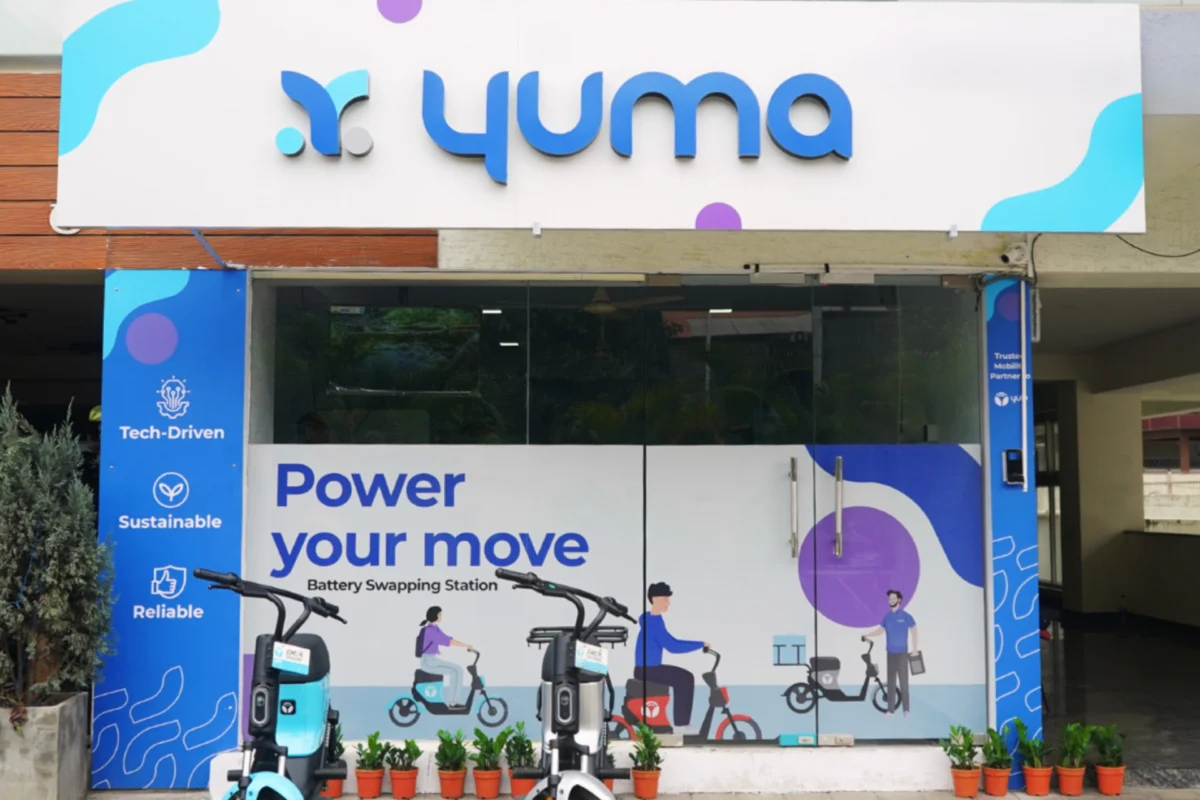
The Canadian automotive giant increases its stake in the battery-swapping joint venture, betting on India’s booming gig economy and two-wheeler electrification.
Introduction
While battery-swapping technology has struggled to gain commercial traction in much of the Western world, Canadian automotive parts giant Magna International is placing a major bet on its viability in India. Magna believes that the country’s unique demographic and economic landscape—characterized by millions of two- and three-wheelers and a rapidly expanding delivery economy—creates a highly favorable environment for the battery-swapping business model to succeed at scale.
To capitalize on this opportunity, Magna has announced an additional $35 million investment in Yuma Energy, a Bengaluru-based battery-swapping network. Yuma, which was spun out of the prominent Indian micromobility startup Yulu in early 2023, has emerged as a key infrastructure provider in India’s electric vehicle (EV) ecosystem. The company has already completed more than 60 million battery swaps to date and has deployed approximately 100,000 batteries across its expanding domestic network.
Main Facts of the Transaction and Operations
Magna International’s latest $35 million cash injection directly increases its ownership stake in Yuma Energy. When the joint venture was initially formed in early 2023, Magna held a controlling 51% stake, with Yulu holding the remaining 49%. According to Muthu Subramanian, Managing Director of Yuma Energy, this new capital infusion will dilute Yulu’s 49% share. While Subramanian confirmed the transaction, he declined to disclose the precise details of the new equity split between Magna and Yulu.
Yulu and Yuma represent Magna’s sole startup investments in the Indian market, reflecting a highly targeted regional strategy. This transaction follows an initial commitment made by Magna in 2022, where the Canadian auto parts manufacturer pledged a combined $77 million to the two businesses—allocating $25 million directly to Yulu and $52 million to the battery-swapping joint venture that eventually became Yuma.
Currently, Yuma Energy operates a proprietary network designed to support electric two- and three-wheelers. Key operational highlights of the entity include:
- Infrastructure Footprint: Over 400 active swapping stations housing more than 2,500 charging units.
- Battery Fleet: Approximately 100,000 active battery packs deployed.
- Historical Volume: Upward of 60 million cumulative battery swaps completed.
- Vertical Integration: In-house design and manufacturing of battery packs at a dedicated facility in Chennai, alongside charging unit production in Bengaluru.
Chronology of Partnership and Development
The strategic relationship between Magna International, Yulu, and Yuma Energy has evolved through several key milestones over the last four years:
2022: The Initial Commitment
Magna International entered the Indian micromobility and battery-swapping market with a combined $77 million investment commitment. Out of this funding, $25 million was directed to Yulu to expand its electric two-wheeler fleet, while $52 million was earmarked to establish a robust, dedicated battery-swapping infrastructure.
Early 2023: The Birth of Yuma Energy
Yuma Energy was officially launched as a carved-out joint venture between Magna and Yulu. The goal was to establish an AI-powered battery charging and swapping network that could service not only Yulu’s captive fleet but also third-party commercial and private electric vehicles. Magna assumed a 51% controlling stake at inception.
March 2026: Financial Year Milestones
Yuma completed its financial year ending March 2026 with an annual revenue of approximately ₹1 billion (around $10.5 million). During this period, the company focused on expanding its geographical presence to 18 Indian cities and refining the unit economics of its individual swapping stations.
August 2026: Yulu’s Fleet Expansion
Yulu secured $93 million in a fresh funding round aimed at aggressively expanding its electric bike fleet to meet the surging demand from the local quick-commerce and delivery sectors. This fleet expansion created an immediate, corresponding demand for Yuma’s swapping network.
Current Period: Magna’s $35 Million Infusion
Magna confirmed its additional $35 million investment to accelerate Yuma’s infrastructure build-out. The capital is earmarked to double Yuma’s battery fleet to 200,000 units and expand its physical network footprint into new high-density metropolitan markets over the next 12 to 18 months.
Supporting Data and Financial Analysis
The economic viability of battery swapping hinges on utilization rates, density, and capital efficiency. Yuma Energy’s financial and operational data reveals a clear path toward profitability, alongside the capital-intensive hurdles typical of utility-scale infrastructure.
| Metric | Current Status (As of Late 2026) | Target (Next 12–18 Months) |
|---|---|---|
| Active Batteries | ~100,000 units | ~200,000 units |
| Swapping Stations | 400+ stations | Expanded footprint in Chennai & Pune |
| Charging Units | 2,500+ units | Significant capacity increase |
| Annual Revenue | ₹1 billion (~$10.5 million) | Projected double-digit growth |
| EBITDA Status | Older stations positive; overall net loss | Corporate EBITDA break-even (2 quarters) |
| Non-Yulu Swap Share | 15% – 20% | 25% |
The Cost of Convenience vs. Fast Charging
Yuma’s business model is positioned as an alternative to fast-charging infrastructure. For gig workers, time spent charging is directly correlated with lost income.
- Swapping Time: Under 2 minutes per exchange.
- Fast-Charging Time: 20 to 30 minutes to achieve an equivalent charge.
- Space and Power Efficiency: Fast-charging hubs require significant real estate and grid power upgrades to charge multiple vehicles simultaneously. In contrast, battery-swapping stations charge batteries sequentially and slowly overnight or during off-peak hours, reducing grid strain and extending overall battery life.
However, this convenience carries a high upfront capital expenditure (CapEx). Yuma must manufacture, distribute, and maintain a surplus of batteries so that fully charged packs are always available when a rider arrives. This "build-ahead" requirement explains why the company is not yet fully profitable at the corporate level, despite individual mature stations operating at positive EBITDA.
Official Responses and Executive Perspectives
Yuma Energy’s leadership remains highly optimistic about the company’s trajectory, emphasizing the alignment between the rise of the gig economy and the operational advantages of battery swapping.
Muthu Subramanian, Managing Director of Yuma Energy, highlighted the critical role of vehicle uptime for commercial delivery riders:
"With Indian gig workers’ high runtime on a daily basis, an EV makes absolute sense in terms of cost of ownership. Uptime is important. A battery can be exchanged in under two minutes, while even a 20- or 30-minute fast charge takes a rider off the road and requires more space and power to serve multiple vehicles at once."
Addressing the capital-intensive nature of the industry and Yuma’s path to profitability, Subramanian added:
"It’s a capital-intensive business, and the unit economics will play out at scale. We are targeting EBITDA break-even within the next two quarters. The bulk of Magna’s investment will be used to expand our swapping infrastructure and double our fleet of batteries over the next 12 to 18 months."
Subramanian also noted that while Yulu remains Yuma’s anchor client, the network is successfully diversifying its customer base:
"About 15% to 20% of swaps in the latest quarter came from customers other than Yulu. We now serve more than five fleets and have integrated our batteries with more than 10 vehicle platforms, including models from Kinetic Green, Motovolt, BGauss, and Quantum Energy. We expect non-Yulu customers to account for about 25% of our swaps within the next two years."
Implications for the Indian EV Ecosystem and Beyond
Magna International’s continued backing of Yuma Energy has broad implications for the Indian electric vehicle market, the gig economy, and the global viability of battery-swapping technology.
1. Sustaining the Quick-Commerce Boom
India’s quick-commerce sector—led by platforms such as Zepto, Blinkit, and Instamart—demands ultra-fast delivery times, often under 10 minutes. This operational intensity requires delivery fleets to remain on the road continuously. By reducing refueling times to under two minutes, Yuma’s battery-swapping network provides the operational continuity necessary to support these rapid delivery timelines. Currently, only 10% to 15% of gig-worker vehicles in India are electric, representing a massive addressable market as fleet operators face regulatory and economic pressure to transition away from internal combustion engines.
2. Vertical Integration as a Strategic Moat
Unlike competitor networks that source third-party hardware, Yuma’s decision to design and manufacture its own battery packs (in Chennai) and charging stations (in Bengaluru) gives it complete control over its technology stack. This vertical integration allows Yuma to optimize battery chemistry for India’s harsh thermal environments, manage supply chain risks, and rapidly deploy firmware updates to improve safety and charging efficiency.
3. De-risking through Diversification
Historically, Yuma’s financial health was tied closely to Yulu’s market performance. By integrating its batteries with ten different vehicle platforms from manufacturers like Kinetic Green and BGauss, Yuma is transitioning into an open-standard utility provider. This diversification de-risks Magna’s investment, ensuring that Yuma can capture market share regardless of which specific EV brand dominates the commercial two-wheeler space.
4. Expansion and International Potential
In the short term, Yuma will focus its resources on deepening its presence in India, specifically targeting new rollouts in Pune and Chennai alongside its existing 18-city footprint. However, the long-term roadmap includes international expansion.
The battery-swapping model developed by Yuma is highly replicable in other high-density, two-wheeler-dominated markets. Southeast Asian countries like Vietnam and Thailand, as well as several rapidly urbanizing nations in Africa, present similar macroeconomic profiles: high density, rising gig-economy employment, and a critical need for low-cost, high-uptime transport. Success in India could position Yuma and Magna as the primary blueprint for urban mobility across the Global South.
