





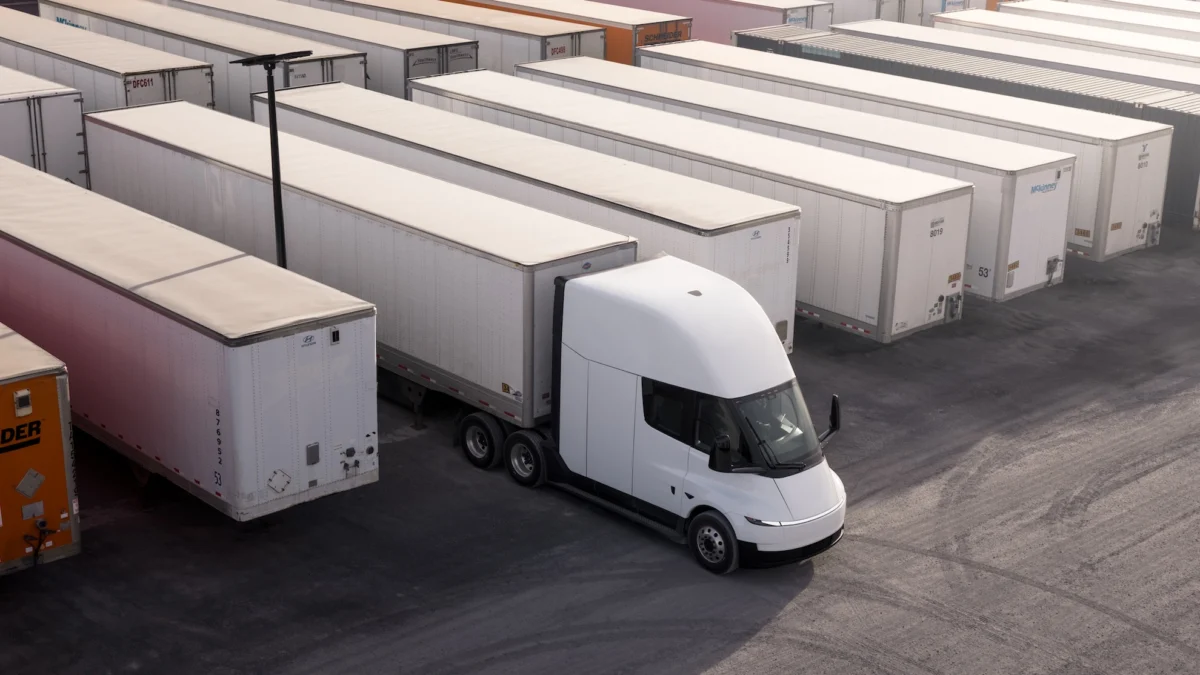
Swedish electric and autonomous transport pioneer Einride has announced a landmark agreement to acquire 500 Tesla Semis. This massive transaction is set to drastically accelerate the decarbonization of heavy-duty freight across North America. The strategic acquisition will see the electric Class 8 trucks integrated into Einride’s managed fleet in phases over the next 24 months, with initial rollouts scheduled to commence in September.
By integrating these high-capacity electric big rigs into its existing ecosystem, Einride aims to offer corporate shippers—including retail giant Amazon—immediate access to zero-emission transport solutions without the prohibitive upfront capital and operational complexities typically associated with fleet electrification. The vehicles will be managed via Einride’s proprietary Saga AI fleet management platform, which orchestrates charging, routing, and deployment to optimize transport efficiency.
1. Main Facts of the Agreement
The deal represents one of the largest commercial commitments to the Tesla Semi to date, positioning Einride as a major intermediary in the transition to sustainable logistics.
+-----------------------------------------------------------------+
|                       DEAL AT A GLANCE                          |
+-----------------------------------+-----------------------------+
| Total Vehicles Ordered            | 500 Tesla Semis             |
| Delivery Timeline                 | 24 months, starting Sept    |
| Core Management Platform          | Saga AI                     |
| Primary Geographic Corridors      | CA, GA, NJ, TX              |
| Financing Structure               | Third-party financed        |
| Target Annual Recurring Revenue   | ~$800 million (converted)   |
+-----------------------------------+-----------------------------+
Phased Integration and Logistics Corridors
The deployment of the 500 Tesla Semis will occur in structured phases over a two-year horizon. Einride plans to position these vehicles along key high-traffic freight corridors in the United States, targeting states with robust logistics infrastructure and supportive regulatory environments for zero-emission vehicles:
- California: Leveraging the state’s advanced charging networks and strict environmental mandates.
- Texas: Serving major inland distribution hubs and interstate shipping lanes.
- Georgia and New Jersey: Connecting critical maritime ports with regional distribution centers.
The "Trucking-as-a-Service" (TaaS) Model
Rather than selling these trucks or acting as a traditional leasing agent, Einride operates on a "Trucking-as-a-Service" (TaaS) business model. Corporate clients do not purchase the vehicles. Instead, they contract with Einride for freight capacity.
Einride provides the entire ecosystem: the vehicle, the driver (where applicable), the charging infrastructure, and the digital orchestration. By utilizing third-party financing to fund the vehicle purchases, Einride preserves its capital while scaling its physical assets to meet enterprise demand.
2. Chronological Development of Einride and Tesla’s Electric Freight Journey
The partnership between Einride and Tesla brings together two companies that have spent years navigating the regulatory, financial, and manufacturing hurdles of the heavy-duty electric vehicle (EV) sector.
  TESLA SEMI TIMELINE                     EINRIDE TIMELINE

  [2017] Concept Unveiled                 [2016] Company Founded
    │                                       │
    ▼                                       ▼
  [2022] First Deliveries (PepsiCo)       [2026] (Apr) Amazon Deal (75 trucks)
    │                                       │
    ▼                                       ▼
  [2026] (Apr) Nevada High-Volume Line    [2026] (Jun) Public IPO
    │                                       │
    ▼                                       ▼
  [2026] (Q2) 4680 Cell Production Focus  [2026] (Jul) Flipturn Acquisition ($38M)
The Path of the Tesla Semi (2017–2026)
Tesla’s journey to commercializing its Class 8 electric truck has been marked by ambitious targets and persistent manufacturing bottlenecks:
- November 2017: Tesla CEO Elon Musk first reveals the Tesla Semi concept, promising production by 2019.
- 2020–2022: Global supply chain disruptions, the COVID-19 pandemic, and battery cell shortages repeatedly delay the truck’s launch.
- December 2022: Tesla delivers its first commercial batch of Semis to early corporate adopters, including PepsiCo, during a highly publicized event at its Gigafactory in Sparks, Nevada.
- April 2026: The first production Semi rolls off Tesla’s newly established high-volume manufacturing line in Nevada, signaling a transition from pilot-scale assembly to industrial-scale production.
- Mid-2026: In its Q2 shareholder letter, Tesla moderates its timeline for full "volume production," citing the need to prioritize battery manufacturing—specifically scaling up its proprietary 4680 cell design—to support both the Semi and the upcoming Cybercab.
The Scaling of Einride (2016–2026)
Founded a decade ago in Sweden, Einride initially gained international attention for its cabless, autonomous "pod" trucks. Over the years, the company has methodically diversified into a full-scale digital and physical freight operator:
- April 2026: Einride secures a high-profile agreement with Amazon to integrate 75 of its heavy-duty electric trucks into Amazon’s Relay freight network, alongside establishing dedicated charging infrastructure across five key U.S. locations.
- June 2026: Einride completes its initial public offering (IPO), raising capital to accelerate its global expansion.
- July 2026: Einride acquires EV charging software provider Flipturn for $38 million, integrating advanced charging management capabilities directly into its operational stack.
- Late 2026: Einride announces its 500-unit Tesla Semi order, marking the largest fleet expansion in the company’s history.
3. Supporting Operational and Financial Data
The acquisition of 500 Tesla Semis is a transformative financial and operational event for Einride, drastically altering its balance sheet potential and market footprint.
+-----------------------------------------------------------------+
|                    FLEET GROWTH PROJECTION                      |
+-----------------------------------+-----------------------------+
| Pre-Deal Fleet Size               | ~200 heavy-duty trucks      |
| Added Tesla Semis                 | 500 trucks                  |
| Projected Fleet Size (Post-24 Mo) | 700+ heavy-duty trucks      |
| Growth Percentage                 | 250% increase               |
+-----------------------------------+-----------------------------+
Tripling Fleet Capacity
Prior to this agreement, Einride operated a fleet of approximately 200 heavy-duty electric trucks across Europe and North America, serving blue-chip clients such as Heineken and PepsiCo. By adding 500 Tesla Semis, Einride will more than triple its operating fleet, instantly making it one of the largest operators of Class 8 electric trucks in the world.
Unlocking the $800 Million Revenue Pipeline
The primary commercial driver behind this deal is the monetization of Einride’s existing pipeline. The company has secured joint business plans with major shippers that represent approximately $800 million in "potential long-term annual recurring revenue" (ARR).
Historically, converting these non-binding joint business plans into contracted, active revenue has been bottlenecked by the lack of available heavy-duty electric vehicles in the market. Securing 500 Semis provides Einride with the physical capacity required to execute these contracts, turning theoretical pipeline value into realized, recurring cash flow.
Synergies with the Flipturn Acquisition
The integration of 500 high-power electric trucks requires massive energy management capabilities. Einride’s $38 million acquisition of Flipturn in July 2026 provides the necessary software infrastructure. Flipturn’s technology allows operators to minimize energy costs by analyzing real-time utility rates, monitoring battery degradation, and coordinating megawatt-level charging schedules—vital tools when operating a fleet of Tesla Semis, which require specialized high-output charging stations.
4. Official Responses
Leadership from both Einride and Tesla have highlighted that while demand for electric heavy transport is at an all-time high, the execution of these projects remains a challenge of industrial scale.
Roozbeh Charli, CEO of Einride, emphasized that the purchase demonstrates the company’s maturity and operational readiness:
"This deployment is yet another proof point that we can execute at the scale our customers demand. Shippers are eager to transition away from diesel, but they cannot afford disruptions to their supply chains. By combining Tesla’s hardware with our Saga AI platform, we are removing the friction of electrification for the world’s largest brands."
Tesla, meanwhile, has focused its communications on the complex manufacturing realities of delivering on such massive orders. In its Q2 2026 shareholder update, the company addressed its production strategy:
"We are continuing to expand our production capacity in Nevada, with a primary focus on scaling our 4680 battery cell manufacturing. Achieving high-volume production of the Tesla Semi and our next-generation autonomous platforms requires a highly optimized battery supply chain. We are working diligently to resolve these manufacturing constraints to meet the deep commercial backlog for the Semi."
5. Strategic Implications for the Electric Trucking Industry
Einride’s 500-truck commitment has deep implications for the broader transport and logistics sector, highlighting the evolving dynamics of fleet ownership, software orchestration, and infrastructure development.
                     ┌──────────────────────────┐
                     │  Einride Saga AI Engine  │
                     └─────────────┬────────────┘
                                   │
         ┌─────────────────────────┼─────────────────────────┐
         ▼                         ▼                         ▼
┌─────────────────┐       ┌─────────────────┐       ┌─────────────────┐
│ Route & Payload │       │ Charging & Grid │       │ Asset Financing │
│ Optimization    │       │ Management      │       │ Off-Balance Sheet│
└─────────────────┘       └─────────────────┘       └─────────────────┘
The Shift to Software-Defined Logistics
This deal highlights that hardware is only one part of the electrification puzzle. A Class 8 electric truck cannot simply be swapped for a diesel truck without systemic changes to routing and scheduling.
Einride’s Saga AI platform acts as the brain of the operation, calculating payload weights, topography, weather, and traffic to determine exactly when and where a truck must charge. By proving that software can successfully mitigate "range anxiety" and optimize charging downtime, Einride is establishing a blueprint for how future commercial fleets will operate.
Decarbonizing Corporate Supply Chains
Enterprise giants like Amazon, PepsiCo, and Heineken face intense pressure from consumers, regulators, and investors to reduce their Scope 3 emissions (indirect emissions within their value chain). Because heavy-duty trucking accounts for a disproportionate share of transport emissions, clean freight is a primary target.
However, these corporations are generally reluctant to take on the asset risk of purchasing unproven electric vehicle technologies or building proprietary charging networks. Einride’s model allows these enterprises to meet their aggressive sustainability targets while keeping their capital free to focus on their core retail and manufacturing businesses.
The Infrastructure Bottleneck
While the acquisition of 500 Semis is a major milestone, the ultimate success of the deployment will depend on the physical grid. Megawatt Charging Systems (MCS)—capable of delivering over a megawatt of power to charge a Class 8 truck in under an hour—require substantial grid connections.
Einride’s regional focus on California, Texas, Georgia, and New Jersey suggests a strategic decision to deploy where utility companies and state regulators are actively investing in high-capacity industrial charging hubs. If successful, this deployment will likely push other logistics corridors to accelerate their grid modernization efforts to keep pace with the shifting demands of commercial transport.
