





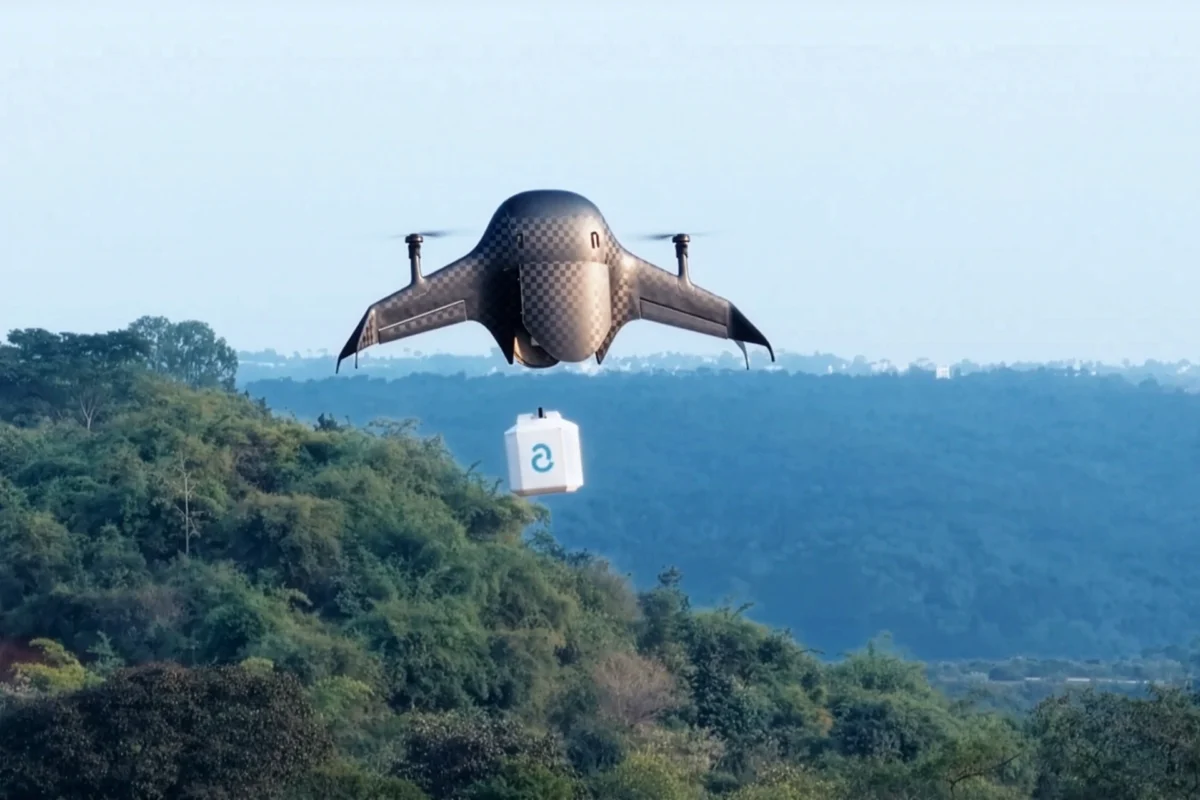
In the global race to revolutionize middle- and last-mile logistics, aerial drone delivery has long promised speed but struggled with cost. A three-year-old Indian startup is attempting to fundamentally rewrite the economics of aerial freight.
Airbound, an autonomous drone manufacturer based in Bengaluru, has raised $37 million in a Series A funding round. The investment is aimed at solving the industry’s most persistent hurdle: making the transport of goods through the air as inexpensive as trucking them by road.
This latest funding round, led by prominent venture capital firm Greenoaks, features participation from major industry players and tech investors, including DoorDash, Lachy Groom, Lightspeed, and Humba Ventures. Coming less than a year after Airbound’s $8.65 million seed round, this cash injection brings the startup’s total capital raised to nearly $50 million—positioning it as one of the most well-funded drone technology players in the region.
1. Main Facts: Redesigning the Physics of Drone Flight
At the core of Airbound’s business model is a radical rejection of conventional drone design. While the commercial drone market has been dominated by quadcopters and heavy multi-rotor aircraft, Airbound’s engineering team argues that these traditional designs are inherently inefficient for commercial logistics.
+-------------------------------------------------------------------+
|                     AIRBOUND'S DESIGN PHILOSOPHY                  |
+-------------------------------------------------------------------+
|  Conventional Multirotors         |  Airbound Tail-Sitter (TRT)   |
|  ------------------------         |  --------------------------   |
|  * Heavy airframe                 |  * Ultra-light composite frame|
|  * High energy spent on self-lift |  * Aerodynamic wing lift      |
|  * High cost per mile             |  * Cost parity with trucking  |
+-------------------------------------------------------------------+
In standard multi-rotor systems, a significant portion of the battery’s energy is expended simply keeping the heavy structural weight of the drone aloft, rather than carrying the actual cargo. This unfavorable payload-to-weight ratio makes short- and medium-distance flights prohibitively expensive for low-margin retail or medical goods.
Airbound’s solution is a lightweight, vertical-flight drone designed to weigh less than the cargo it carries. Founded by Naman Pushp, the startup has pioneered a "tail-sitter" aerodynamic design.
The Tail-Sitter Design Advantage
- Vertical Takeoff and Landing (VTOL): The aircraft takes off vertically from an upright position, eliminating the need for runways or specialized launching pads.
- Horizontal Transition: Once in the air, the drone transitions 90 degrees into a horizontal flight path, using its wings to generate aerodynamic lift rather than relying solely on rotor thrust.
- Operational Efficiency: By relying on wing lift during the cruise phase, the drone consumes significantly less power, dramatically extending its range and lowering operational costs.
Airbound’s current operational model, the TRT, weighs just 3.3 pounds (1.5 kg) yet is capable of carrying a 2.2-pound (1 kg) payload. The company is currently developing its next-generation aircraft, which is projected to weigh 6.6 pounds (3 kg) and carry an 11-pound (5 kg) payload. By keeping the structural weight of the aircraft below the weight of the cargo, Airbound aims to achieve unprecedented unit economics in aerial logistics.
2. Chronology: From Concept to a $50 Million Valuation
Airbound’s rapid rise from a stealth hardware project to a highly capitalized logistics disrupter highlights the accelerating investor appetite for deep-tech physical infrastructure.
  2023: Airbound Founded in Bengaluru
    │
    ├── Late 2023/Early 2024: Raises $8.65M Seed Round
    │
    ├── 2024: Completes 13,000+ autonomous test flights
    │         Partners with Narayana Health for medical transport
    │
    └── Late 2024: Secures $37M Series A led by Greenoaks
Announces plans for a 3-city network in Andhra Pradesh- 2023: Inception and Early Prototyping
Airbound is founded in Bengaluru, India, by Naman Pushp. The startup establishes its headquarters and R&D facilities with a focus on solving the structural weight issues plaguing commercial drones. - Late 2023 / Early 2024: Seed Funding Inflow
The company raises an $8.65 million seed round to build out its manufacturing facilities and transition from early-stage prototypes to commercial-grade autonomous aircraft. - 2024: Operational Testing and Scaling
Airbound completes over 13,000 autonomous test flights across Bengaluru and Guntur. The startup secures a major partnership with the renowned hospital network Narayana Health, conducting more than 1,000 successful diagnostic sample deliveries. - Late 2024: Series A Expansion
Airbound secures $37 million in Series A funding. The capital is earmarked for expanding its manufacturing capabilities, developing larger-payload aircraft, and establishing a regional drone delivery network.
3. Supporting Data: Quantifying the Operational Impact
The commercial viability of Airbound’s technology is best demonstrated through its real-world performance metrics, particularly in its ongoing partnership with Narayana Health.
Case Study: Narayana Health Diagnostics Link
In traditional medical logistics, transporting blood samples and diagnostic specimens between clinics and centralized laboratories is highly inefficient. Road transport in dense urban areas like Bengaluru is plagued by unpredictable traffic congestion.
| Logistics Metric | Road Transport (Truck/Courier) | Airbound Autonomous Drone |
|---|---|---|
| Travel Time (2.5-mile route) | 3 to 5 hours (including aggregation time) | 7 minutes |
| Logistical Process | Batching/bundling samples to justify road costs | Point-to-point, immediate dispatch |
| Environmental Impact | Carbon-intensive combustion engine idling | Zero-emission electric flight |
Because road couriers must bundle multiple samples together to make a trip financially viable, diagnostic specimens often sit waiting for hours. Airbound’s TRT drone bypasses this entire aggregation bottleneck, flying samples individually across a 2.5-mile corridor in just seven minutes.
Traditional Road Logistics (3-5 Hours)
[Sample Collected] ──> [Wait for Batching] ──> [Traffic Congestion] ──> [Lab Arrival]

Airbound Drone Logistics (7 Minutes)
[Sample Collected] ──> [Immediate Launch] ──> [Direct Flight Path] ──> [Lab Arrival]
This operational efficiency has fundamentally altered how Narayana Health approaches its physical footprint. The healthcare provider’s new Banashankari hospital in Bengaluru has been constructed without an on-site diagnostic laboratory or blood bank. Instead, the facility will rely entirely on Airbound’s drone network to shuttle samples to and from centralized testing facilities in real time.
Scaling to a Three-City Network
Airbound’s ambitions extend far beyond localized medical deliveries. The startup has signed a memorandum of understanding with the state government of Andhra Pradesh to build a regional drone delivery network connecting three major cities.
- Target Daily Volume: 10,000 flights per day.
- Target Sectors: Retail, e-commerce, and healthcare logistics.
- Fleet Requirements: Between 250 and 1,000 active aircraft, depending on final route configurations and average distance.
- Manufacturing Footprint: Airbound operates a 43,000-square-foot facility in Bengaluru, where it designs and manufactures its proprietary airframes, avionics, and flight control systems in-house.
4. Official Responses: The "Boeing" Philosophy of Drone Logistics
While several drone delivery startups operate as end-to-end logistics companies—essentially acting as "airlines" that manage both the hardware and the consumer-facing delivery service—Airbound is taking a fundamentally different strategic path.
Naman Pushp, founder and CEO of Airbound, envisions his company as an aerospace manufacturer rather than a local delivery service.
"We want to build towards a world where everything has cost parity with trucking," Pushp stated. "That’s the Boeing role—the aircraft airlines everywhere rely on, not the airline itself."
+-------------------------------------------------------------+
|                AIRBOUND'S MARKET POSITIONING                |
+-------------------------------------------------------------+
|  THE "AIRLINE" MODEL             |  THE "BOEING" MODEL      |
|  (Skye Air, TSAW, etc.)          |  (Airbound's Strategy)   |
|  -------------------             |  ------------------      |
|  * Operates consumer deliveries  |  * Manufactures aircraft |
|  * Manages local logistics hubs  |  * Licenses technology   |
|  * High operational overhead     |  * Scales via partners   |
+-------------------------------------------------------------+
By focusing on hardware engineering and software autonomy, Airbound intends to sell or license its aircraft to third-party logistics firms, e-commerce giants, and postal services, allowing them to operate their own aerial fleets.
This hardware-first approach is reflected in the company’s financial planning. Despite employing more than 150 engineers and technicians, Airbound remains broadly pre-revenue, prioritizing long-term capital efficiency and structural scaling over immediate commercial monetization.
"The goal is to be a giant in a few decades, not to make revenue as soon as we can," Pushp added.
Regarding the landmark agreement with the Andhra Pradesh government, Pushp clarified that the partnership does not involve direct state subsidies or financial contracts. Instead, the government is collaborating with Airbound to establish the necessary regulatory frameworks, airspace permissions, and safety protocols to make a high-density, 10,000-flight-a-day network legally and operationally viable.
5. Implications: Navigating Regulatory and Competitive Skies
Airbound’s successful Series A funding round comes at a critical juncture for the commercial drone industry, both in India and globally. The startup’s success will depend heavily on its ability to navigate complex regulatory landscapes and out-engineer a growing cohort of domestic and international competitors.
The Regulatory Bottleneck: Beyond Visual Line of Sight (BVLOS)
The primary obstacle preventing drone logistics from achieving massive scale is not hardware capability, but aviation regulation. In most jurisdictions, including India, civil aviation authorities place strict limits on drone flights, typically requiring operators to maintain visual contact with the aircraft.
For a commercial drone network to operate efficiently over miles of suburban or urban terrain, operators must secure Beyond Visual Line of Sight (BVLOS) certifications.
                          VISUAL LINE OF SIGHT (VLOS)
                    [Operator] <--- (Direct Sight) ---> [Drone]
                                 (Max ~0.5 miles)

                     BEYOND VISUAL LINE OF SIGHT (BVLOS)
[Operator] ... (LTE / Satellite Link) ... [Drone] ──> [Target] ──> [Destination]
                                 (Unlimited range)
Without BVLOS approvals, the unit economics of drone delivery collapse, as companies must employ spotters along flight paths, erasing the cost advantages of automation. While the Indian government has taken progressive steps to liberalize its airspace through the DigitalSky platform, securing routine BVLOS clearances for high-density networks remains a slow, bureaucratic process.
The Competitive Landscape in India
Airbound enters a market populated by several well-funded domestic players, each vying for dominance in the emerging aerial logistics sector:
- Skye Air Mobility: Actively operating medical and e-commerce cold-chain delivery corridors across multiple Indian states.
- TSAW Drones: Building end-to-end logistics supply chains using proprietary drone hubs and software.
- Garuda Aerospace: A major drone manufacturer and service provider that has aggressively targeted agricultural and consumer delivery applications.
Airbound’s decision to position itself as an OEM (Original Equipment Manufacturer) rather than a direct service operator could shield it from the costly customer-acquisition wars and operational friction that consumer-facing delivery networks face. If Airbound can prove that its tail-sitter design delivers significantly lower per-mile operating costs than its competitors’ multi-rotors, it could become the default hardware provider for the very logistics networks it competes with for airspace.
Broad Structural Implications for Global Logistics
If Airbound achieves its goal of cost parity with road transport, the implications for global supply chains, urban planning, and healthcare infrastructure are profound.
- Decentralized Medical Infrastructure: As demonstrated by Narayana Health’s lab-free hospital design, instant aerial transport allows healthcare providers to centralize expensive diagnostic equipment, reducing capital expenditures for new clinics and improving access to specialized care in remote areas.
- Reimagining E-commerce Warehousing: E-commerce giants could transition from sprawling, expensive urban fulfillment hubs to larger, centralized warehouses located outside major metropolitan areas, relying on high-speed autonomous drone corridors to fulfill same-day deliveries.
- Environmental and Congestion Relief: Shifting a meaningful percentage of lightweight package deliveries from roads to the air would reduce urban traffic congestion and lower the carbon footprint associated with idling delivery vehicles in congested metropolitan centers.
Airbound’s $37 million Series A is a major bet on a future where the air is as critical to local commerce as the highway. Whether the startup can successfully scale its manufacturing, clear regulatory hurdles, and achieve its target of 10,000 daily flights remains to be seen—but its radical approach to aircraft design has officially established it as a formidable force in the future of logistics.
