




As autonomous and electric vehicles transition from experimental fleets to mainstream consumer products, the underlying hardware powering their self-driving capabilities has emerged as the latest battleground in the geopolitical and technological standoff between the United States and China.
At the center of this escalating tension is Light Detection and Range (lidar) technology—the laser-based sensor systems that allow autonomous vehicles (AVs) to "see" and navigate their surroundings. A Department of Energy (DOE) national laboratory has launched an investigation into whether Chinese-manufactured lidar sensors pose a systemic national security and cybersecurity threat to American infrastructure, according to sources familiar with the matter.
1. Main Facts: The Idaho National Laboratory Investigation
The review is being conducted by the Idaho National Laboratory (INL), a prominent federal research center renowned for its work on national security, nuclear energy, and critical infrastructure protection. According to two sources who spoke on the condition of anonymity, the INL’s investigation is not entirely a government-mandated initiative; rather, it is being funded by a private entity—either a single company or a coalition of companies—operating within the electric vehicle (EV) and autonomous vehicle industries.
The core objective of the INL review is to evaluate the cyber-vulnerabilities of Chinese-made lidar systems. Specifically, the laboratory is analyzing whether these sensors contain "back doors" or other security flaws that could allow foreign adversaries to compromise vehicle control systems, harvest highly detailed geographic data, or disrupt American transportation networks.
At the same time, sources suggest the review could serve a dual purpose: either exposing critical flaws to justify policy bans or potentially providing a "clean bill of health" for specific Chinese components, allowing automakers to continue utilizing them with greater regulatory confidence.
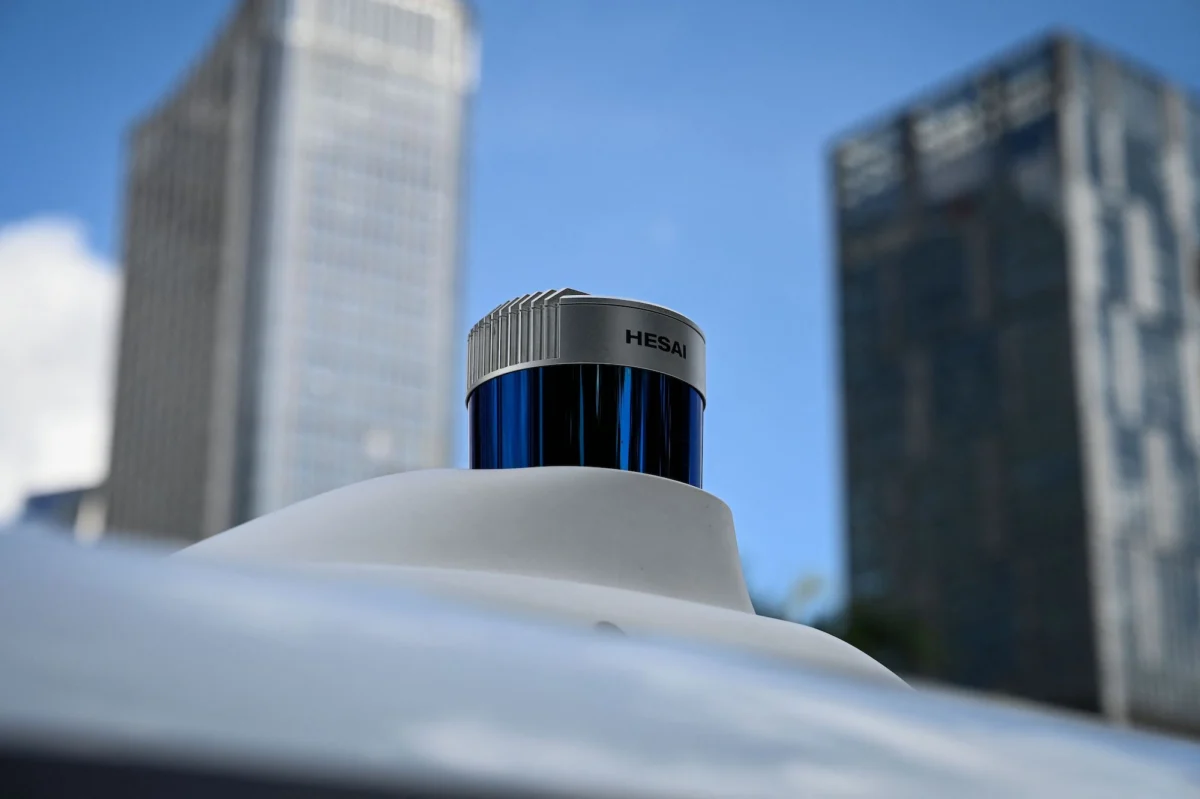
The investigation targets the products of dominant Chinese lidar manufacturers, most notably Hesai Technology and RoboSense. These companies have successfully commercialized low-cost, high-performance lidar sensors, capturing significant market share among global automakers and AV developers.
2. Chronology: The Road to Regulatory Scrutiny
To understand the urgency behind the INL’s probe, it is necessary to trace the rapid evolution of the lidar market and the corresponding escalation of U.S. regulatory oversight.
+-----------------------------------------------------------------------------------+
|                                 CHRONOLOGY OF EVENTS                              |
+-----------------------------------------------------------------------------------+
|  • Mid-2010s: Lidar costs exceed $75,000 per unit; technology is highly restricted.|
|                                                                                   |
|  • Late 2010s - Early 2020s: Chinese suppliers (Hesai, RoboSense) scale           |
|    manufacturing, driving costs down to several hundred dollars per unit.         |
|                                                                                   |
|  • Early 2024: A leap-year software bug causes widespread, day-long outages       |
|    across autonomous vehicle fleets utilizing Hesai lidar sensors.                |
|                                                                                   |
|  • March 2024: Rivian CEO RJ Scaringe reveals discussions regarding domesticating |
|    lidar production using Chinese technology or joint ventures outside China.     |
|                                                                                   |
|  • Mid-2024: Congress introduces bipartisan legislation (e.g., Securing           |
|    Infrastructure from Adversaries Act) aimed at banning Chinese lidar.           |
|                                                                                   |
|  • 2025: U.S. Commerce Department bans Chinese connectivity hardware in passenger |
|    vehicles, leaving physical sensors like lidar in a regulatory gray area.       |
|                                                                                   |
|  • Present: Idaho National Laboratory conducts its industry-funded security       |
|    review of Chinese lidar sensors.                                               |
+-----------------------------------------------------------------------------------+
The Cost Revolution and Market Dominance
A decade ago, lidar was a prohibitively expensive luxury reserved for well-funded research laboratories. A single high-end lidar unit could cost upwards of $75,000, making mass-market integration impossible.
Over the last several years, Chinese manufacturers leveraged state subsidies, lower labor costs, and rapid industrial scaling to disrupt the market. By mass-producing solid-state and mechanical lidar units, companies like Hesai and RoboSense reduced unit costs to a few hundred dollars. This cost collapse forced Western competitors into severe financial distress, leading to industry consolidation and high-profile bankruptcies across the U.S. lidar sector.
The Leap-Year Bug of 2024
In early 2024, a seemingly minor technical glitch provided a stark demonstration of the systemic vulnerabilities associated with foreign-sourced sensor software. A software bug related to leap-year calculations caused Hesai lidar sensors across various AV fleets to stop functioning simultaneously.
For an entire day, robotaxis and autonomous delivery vehicles utilizing these sensors were rendered inoperable. While the incident was attributed to an oversight rather than malicious intent, it proved to national security officials that a single software anomaly could instantly paralyze automated transportation networks.
The 2025 Regulatory Pivot
The geopolitical landscape shifted dramatically when the U.S. Department of Defense placed both Hesai and RoboSense on its 1260H list, designating them as companies with ties to the Chinese military (People’s Liberation Army).
This was followed by a 2025 Department of Commerce ruling that prohibited the integration of Chinese-made connectivity hardware and software in U.S. passenger vehicles. However, this ban specifically targeted telematics and communications modules, leaving physical perception sensors like lidar in a regulatory gray area. This loophole spurred lawmakers to draft targeted legislation, such as the Securing Infrastructure from Adversaries Act, to close the gap.
3. Supporting Data: The Economics and Technology of Lidar
To evaluate the potential risks of Chinese lidar, it is essential to analyze the technical capabilities of these sensors alongside the economic realities of the global automotive supply chain.
How Lidar Works
Lidar operates by emitting millions of laser pulses per second and measuring the time it takes for those pulses to bounce off surrounding objects. By calculating these time-of-flight measurements, the sensor constructs a highly accurate, real-time three-dimensional map of the environment, known as a "point cloud."
   [ Lidar Sensor ] ---> (Laser Pulses) ---> [ Obstacle / Roadside ]
          ^                                         |
          |                                         v
   [ Data Processor ] <--- (Reflected Light) <------+
          |
          v (Real-time 3D Point Cloud Generation)
While Tesla has famously rejected lidar in favor of a camera-only "vision" approach—with CEO Elon Musk labeling the technology a "crutch"—the vast majority of the AV and advanced driver-assistance systems (ADAS) industry views lidar as an indispensable redundancy tool, particularly in low-light or adverse weather conditions.
Market Polarization and Cost Comparison
The economic chasm between domestic and foreign lidar production has created a dependency trap for Western automakers:
| Metric | Western Lidar Manufacturers (Historical) | Chinese Lidar Manufacturers (Current) |
|---|---|---|
| Average Unit Cost | $10,000 – $75,000 | $100 – $1,000 |
| Production Scale | Low-volume, customized batches | High-volume, automated assembly lines |
| Capital & Labor Costs | High R&D overhead, high labor costs | State-subsidized capital, low labor costs |
| Market Position | Consolidating, facing restructuring | Dominant market share in global ADAS/AV |
This price discrepancy has forced American electric vehicle startups and legacy automakers to look toward China. For example, Rivian planned to integrate a roof-mounted lidar sensor into its highly anticipated R2 SUV platform. To balance costs, Rivian’s leadership openly discussed leveraging Chinese technology through potential joint ventures to manufacture sensors outside of China, though the company’s CFO later clarified that there were no active plans to bring lidar development entirely in-house.
4. Official Responses: The Wall of Silence
The sensitive nature of the INL probe and the looming threat of federal bans have created a wall of silence across both the public and private sectors.
Government and Laboratory Stances
The Idaho National Laboratory has refused to disclose any details regarding the review. When questioned, an INL spokesperson reiterated a standard non-disclosure position:
"This isn’t a project that we’re at liberty to discuss with reporters."
Congressional Alarm
In contrast to executive branch discretion, congressional lawmakers have been vocal about the perceived threat. Senator Tammy Baldwin (D-WI), a co-sponsor of the Securing Infrastructure from Adversaries Act, emphasized the espionage risks:
"As infrastructure becomes more sophisticated, the threat Chinese LiDAR technology poses to American communities and our national security cannot be allowed to go unchecked. We need to be doing more to protect Americans and that starts with ensuring taxpayer dollars aren’t being used to purchase technologies that could be used to spy on us."
Representative John Moolenaar (R-MI), Chairman of the House Select Committee on the Chinese Communist Party, echoed these concerns, warning of potential hardware backdoors:
"I am deeply concerned that back doors built into these sensors could transmit highly sensitive geospatial information back to Chinese Communist interests, giving foreign adversaries a blueprint of our critical infrastructure."
Industry Denials and "No Comments"
Automakers and technology providers have distanced themselves from the ongoing investigation. Representatives for GM, Ford, Rivian, Lucid Motors, Kodiak, Nuro, and Uber all stated they were unaware of the INL review. Major AV and semiconductor players, including Nvidia, Zoox, and Aurora, did not respond to inquiries regarding their potential involvement in funding or supporting the laboratory’s research. Similarly, Chinese suppliers Hesai and RoboSense did not comment on the security allegations.
5. Strategic Implications: Cybersecurity, Espionage, and Supply Chains
The INL review highlights a broader debate over the nature of hardware-level security in connected vehicles. Experts point to three distinct risk vectors associated with the widespread adoption of Chinese lidar.
Cybersecurity Risk 1: The "Kill Switch" Scenario
The most dramatic risk involves the potential for a coordinated, remote disabling of vehicle sensors. If a foreign adversary gained access to the firmware update mechanisms of a major lidar supplier, they could theoretically transmit a malicious command to disable all active sensors simultaneously.
Given that autonomous vehicles rely on lidar for real-time collision avoidance, a sudden sensor blackout could cause immediate safety hazards on public roads, effectively bricking transport fleets and disrupting supply chains.
+-----------------------------------------------------------------------------+
|                         REMOTE DISABLE ("KILL SWITCH")                      |
+-----------------------------------------------------------------------------+
|  [ Adversary Server ] ---> (Malicious Firmware Update) ---> [ Cellular Chip ]|
|                                                                    |        |
|                                                                    v        |
|  [ Vehicle Inoperable ] <--- (Sensors Deactivated) <--- [ Lidar Processor ]  |
+-----------------------------------------------------------------------------+
Cybersecurity Risk 2: Data Exfiltration and Infrastructure Mapping
A more insidious threat is the potential for covert data collection. Lidar sensors generate dense, highly accurate 3D maps of their surroundings. If a vehicle is driving near military bases, power plants, or government offices, its sensors are actively mapping those facilities in high resolution.
Omer Keilaf, CEO and co-founder of Israeli lidar firm Innoviz, notes that compressing and transmitting this data is highly feasible:
"As a person that spent seven years in the [Israeli] intelligence force, I can assure you, it’s not very difficult to extract that information. Eventually, the amount of data that the lidar is generating is pretty easily compressed if someone wants to."
By embedding a cellular modem or leveraging the vehicle’s primary connectivity unit, compromised lidar hardware could quietly exfiltrate compressed spatial data back to foreign servers, creating a dynamic, crowdsourced map of American infrastructure.
The Supply Chain Dilemma
For Western automakers, the ultimate risk is regulatory whiplash. If the INL probe uncovers definitive vulnerabilities, it could trigger an outright ban on Chinese lidar components.
Automakers that have designed their entire autonomous driving software stacks around the specific physical and optical characteristics of Hesai or RoboSense sensors would face a massive engineering challenge. Replacing a core sensor requires rewriting perception algorithms, recalibrating vehicle control units, and re-undergoing expensive safety certifications.
Ultimately, the Idaho National Laboratory’s investigation underscores a growing consensus in Washington: in the age of software-defined vehicles, a car is no longer just a mode of transportation—it is a mobile, connected computer, and every sensor in its stack represents a potential entry point for foreign surveillance and disruption.
