




Main Facts: The Federal Probe and the Geopolitical Crosshairs
A premier U.S. Department of Energy national laboratory has launched an investigation into whether light detection and ranging (lidar) sensors manufactured in China pose a national security risk to the United States. The review, conducted by the Idaho National Laboratory (INL), is focusing on the potential vulnerabilities of these sensors if they become widely integrated into passenger and commercial vehicles across the nation.
According to sources familiar with the matter who spoke on the condition of anonymity, the federal probe is not being driven solely by government initiative. Instead, the research is funded by a private sector entity—or a coalition of companies—operating within the electric vehicle (EV) and autonomous vehicle (AV) industries. The specific identities of the corporate sponsors backing the INL review remain undisclosed.
Lidar technology, which uses laser pulses to construct highly detailed three-dimensional maps of a vehicle’s surroundings, has become a cornerstone of modern self-driving vehicle suites. However, the technology has also emerged as a major flashpoint in the broader geopolitical and technological rivalry between Washington and Beijing.
The INL review is underway at a critical moment. While the laboratory has declined to comment on the specific parameters of its research, the investigation is occurring against a backdrop of intensifying congressional pressure to ban Chinese-made lidar from American roads. Lawmakers have expressed concerns that these sensors could be weaponized for cyber warfare, intelligence gathering, or industrial espionage.
Chronology of Escalating Pressures on Chinese Lidar
The scrutiny surrounding Chinese lidar did not emerge in a vacuum. It is the result of a multi-year escalation of regulatory, legislative, and operational developments that have transformed a niche automotive component into a matter of national defense.
[Early 2024] ───► Hesai Leap Year Bug halts autonomous fleets globally
[Mid-2024]   ───► DoD places Hesai & RoboSense on the 1260H Military List
[2025]       ───► Commerce Department bans Chinese connectivity hardware in US cars
[Current]    ───► Congress advances bipartisan bills targeting Chinese Lidar; INL launches probe
The 2024 Leap Year Glitch
In early 2024, a significant software failure thrust Chinese lidar manufacturer Hesai Technology into the spotlight. A programming oversight in Hesai’s firmware failed to properly account for the leap year’s extra day, causing autonomous vehicles utilizing their sensors to suddenly stop functioning for an entire day. While the incident was ultimately resolved and attributed to a software bug, it served as a stark, real-world proof of concept for national security analysts. It demonstrated how a single software vulnerability or coordinated firmware update from a foreign supplier could instantly paralyze entire fleets of autonomous vehicles.
The Department of Defense Blacklist
By mid-2024, the U.S. Department of Defense (DoD) took formal action by placing China’s leading lidar manufacturers, Hesai Technology and RoboSense, on its "1260H" list of Chinese military-linked companies. This designation identifies entities suspected of assisting the People’s Liberation Army (PLA). While the listing primarily restricts these companies from securing U.S. military procurement contracts, it sent a powerful warning to the commercial automotive sector about the perceived risks of long-term reliance on these suppliers.
The 2025 Connectivity Ban
The regulatory environment tightened further in 2025 when the U.S. Department of Commerce implemented a landmark rule prohibiting the integration of Chinese-developed connectivity hardware and software in passenger vehicles operating on American roads. This rule targeted telematics and onboard communication systems capable of transmitting data outside the vehicle. However, the regulation left a critical loophole: autonomous vehicle sensors, including lidar and cameras, were not explicitly prohibited under the ban, leaving the door open for continued commercial use.
The Current Legislative Pincer Movement
Recognizing this regulatory gap, lawmakers in both houses of Congress have mobilized to introduce targeted legislation.
- The Securing Infrastructure from Adversaries Act: Spearheaded by Senator Tammy Baldwin (D-WI) and Senator Ted Budd (R-NC), this bipartisan bill seeks to prohibit the use of Chinese lidar in critical infrastructure projects and federally funded transit systems.
- The House Select Committee Initiative: Representative John Moolenaar (R-MI), Chairman of the House Select Committee on the Chinese Communist Party, alongside Representative Raja Krishnamoorthi (D-IL), has co-sponsored separate legislation aiming for a comprehensive ban on the importation and use of Chinese lidar in the United States.
Supporting Data: Technical Mechanics, Market Dominance, and Vulnerabilities
To understand why Chinese lidar has drawn such intense federal and legislative scrutiny, it is necessary to examine the underlying technology, the economics of the global supply chain, and the specific cyber-attack vectors identified by national security experts.
+-------------------------------------------------------------------------+
|                         LIDAR DATA EXFILTRATION PATHWAY                  |
|                                                                         |
|  [Laser Pulses] --> [3D Point Cloud Map] --> [Onboard Compression]      |
|                                                     |                   |
|  [Foreign Intelligence Server] <-- [Cellular Chip] <+                   |
+-------------------------------------------------------------------------+
How Lidar Functions and What It Collects
Lidar operates by emitting millions of infrared laser beams per second and measuring the time it takes for those beams to bounce off surrounding objects. This "time-of-flight" data is processed in real time to generate a "point cloud"—a highly accurate, continuous 3D representation of the physical environment.
Unlike cameras, which can be limited by low light, or radar, which lacks spatial resolution, lidar provides centimeter-grade accuracy. Because autonomous vehicles must continuously map their surroundings to navigate safely, a vehicle equipped with lidar is effectively a mobile, high-resolution 3D scanning platform.
The Economic Divide: How China Cornered the Market
For years, lidar was a prohibitively expensive technology. A decade ago, a single high-performance lidar unit from pioneering Western manufacturers could cost as much as $75,000, limiting its use to academic research and early-stage experimental vehicle fleets. This high barrier to entry led some companies, most notably Tesla and its CEO Elon Musk, to reject the technology entirely, with Musk famously calling lidar a "crutch" and opting to build Tesla’s self-driving architecture around cameras alone.
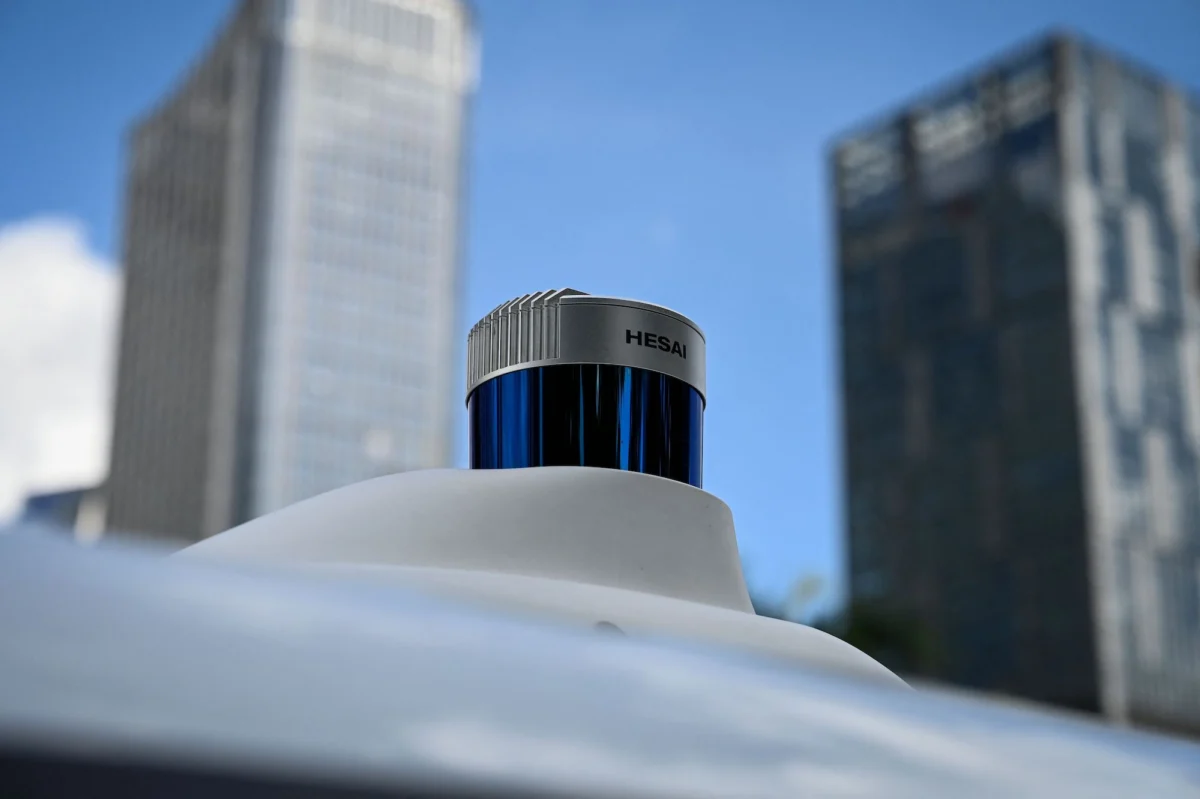
However, Chinese manufacturers took a different strategic path. Supported by government subsidies, lower costs of capital, and massive domestic manufacturing ecosystems, companies like Hesai and RoboSense successfully scaled production. Within a decade, they brought the cost of a high-resolution lidar sensor down from tens of thousands of dollars to just a few hundred dollars.
This dramatic price reduction put immense pressure on Western competitors. Lidar developers in the United States and Europe struggled to match China’s economies of scale. The resulting market pressures led to a wave of consolidation, layoffs, and financial restructuring across the Western lidar sector, exemplified by the high-profile struggles and restructuring of companies like Luminar. As a result, U.S. automakers and autonomous vehicle developers looking to deploy self-driving technology economically have found themselves highly reliant on Chinese suppliers.
The Cybersecurity Threat Vector
The Idaho National Laboratory’s review is reportedly focused on two primary cybersecurity vulnerabilities associated with Chinese-manufactured lidar:
- The Remote "Kill Switch" Disruption: Security analysts fear that if hundreds of thousands of commercial trucks, delivery vans, and passenger vehicles on American roads rely on Chinese lidar, a state-sponsored actor could exploit a zero-day vulnerability or push a malicious firmware update. This could disable the sensors simultaneously, causing immediate, widespread disruption to the transportation sector and supply chains.
- Data Exfiltration and Espionage: Lidar sensors collect highly detailed spatial data, including the layouts of military installations, government offices, ports, and power grids. Omer Keilaf, CEO and co-founder of the Israeli lidar firm Innoviz and a former officer in the Israeli intelligence services, has warned that this spatial data can be easily compressed. If the lidar unit is connected to a vehicle’s telematics system or contains an embedded cellular chip, this compressed data could be quietly transmitted to foreign servers, providing foreign intelligence agencies with a continuously updated 3D map of sensitive American infrastructure.
Official Responses: Corporate Caution and Strategic Silence
The sensitive nature of the federal investigation has met with a wall of silence and cautious denials from both government officials and industry leaders.
Federal and Supplier Responses
- Idaho National Laboratory: The INL has consistently declined to provide details on the scope, progress, or sponsors of the review. A spokesperson for the laboratory stated, "This isn’t a project that we’re at liberty to discuss with reporters."
- Hesai and RoboSense: The leading Chinese lidar suppliers did not respond to multiple requests for comment regarding the INL investigation or the allegations raised by U.S. lawmakers. Both companies have previously denied that their products pose any security risk, asserting that their sensors are designed solely for civilian automotive safety.
The Automotive and AV Sector
TechCrunch reached out to several prominent automotive and autonomous vehicle companies that have reportedly evaluated or utilized Chinese lidar components. The responses reveal a industry-wide effort to distance themselves from the political fallout:
| Company | Stated Position on INL Review |
|---|---|
| Rivian | Denied awareness of the ongoing INL review. |
| General Motors | Denied awareness of the ongoing INL review. |
| Ford | Denied awareness of the ongoing INL review. |
| Lucid Motors | Denied awareness of the ongoing INL review. |
| Kodiak Robotics | Denied awareness of the ongoing INL review. |
| Nuro | Denied awareness of the ongoing INL review. |
| Uber | Denied awareness of the ongoing INL review. |
| Nvidia | Did not respond to inquiries. |
| Zoox (Amazon) | Did not respond to inquiries. |
| Aurora Innovation | Did not respond to inquiries. |
The Rivian Strategy and Shift
Rivian’s approach highlights the difficult balancing act facing American automakers. The company plans to integrate lidar into the roofline of its upcoming R2 SUV platform to support advanced driver-assistance features.
In early 2024, Rivian CEO RJ Scaringe indicated that the company was exploring the possibility of manufacturing its own lidar sensors within the United States by leveraging established Chinese technology, potentially through a joint venture. Scaringe noted that several automakers were discussing how to collaboratively build production capacity outside of China to mitigate geopolitical risks. However, shortly after these comments, Rivian’s Chief Financial Officer clarified that the company had no immediate plans to bring lidar development in-house, reflecting the high capital costs and technical hurdles of independent manufacturing.
Strategic and Economic Implications for the Autonomous Future
The outcome of the Idaho National Laboratory’s investigation and the progress of the pending congressional bills could have profound consequences for the future of transportation, trade, and national security policy.
Supply Chain Disruption and Cost Escalation
If Congress proceeds with a comprehensive ban on Chinese-made lidar, American automakers and AV developers will face immediate supply chain challenges. Transitioning away from established suppliers like Hesai and RoboSense would require companies to re-engineer their sensor suites and software stacks to accommodate alternative Western hardware.
Because Western lidar manufacturers currently operate at a lower production scale, this shift would likely increase per-vehicle manufacturing costs. For startups and pre-revenue autonomous trucking companies, these added expenses could delay commercial deployments and strain capital reserves.
The "Friend-Shoring" Dilemma
A ban on Chinese lidar would likely accelerate the trend of "friend-shoring"—restructuring supply chains to rely only on friendly nations. This would benefit lidar developers based in the United States, Europe, and allied countries like Israel.
However, building out the domestic manufacturing capacity required to replace Chinese production volume will take years. Automakers may attempt to license Chinese intellectual property to manufacture sensors locally, but this strategy could still face legislative pushback if lawmakers remain concerned about underlying software vulnerabilities and royalty flows to foreign entities.
The Evolution of Vehicle Security
The scrutiny of lidar indicates a broader shift in how national security agencies view modern vehicles. Passenger cars and commercial trucks are no longer seen merely as mechanical transport, but as sophisticated, connected data centers on wheels.
As software-defined vehicles become the industry standard, hardware components like lidar, cameras, and radar are increasingly analyzed through the lens of national security. The INL’s investigation may set a precedent for future federal reviews of other imported automotive technologies, establishing a more rigorous security standard for the global automotive supply chain.
