





Lucid Motors has announced a sweeping strategic overhaul designed to pull the luxury electric vehicle (EV) manufacturer out of a prolonged period of unchecked spending and mounting inventory. Dubbed an "operational reset," the aggressive turnaround plan is being spearheaded by the company’s newly appointed Chief Executive Officer, Silvio Napoli. The multi-pronged initiative centers on achieving $1.4 billion in cash reductions while simultaneously prioritizing three "must-win" commercial pillars: launching a highly anticipated mid-sized EV platform, completing its manufacturing facility in Saudi Arabia, and deploying a premium robotaxi service in partnership with Uber and Nuro.
The announcement, made during the company’s second-quarter 2026 earnings call, marks a critical turning point for the California-based EV maker. Confronted with widening net losses and persistent execution bottlenecks, Lucid is attempting to transition from an ultra-luxury niche automotive brand into a leaner, more diversified mobility and technology provider.
Chronology of a Corporate Turnaround: How Lucid Reached the Brink
The dramatic restructuring announced by Napoli is the culmination of months of mounting operational pressure, leadership shakeups, and aggressive cost-cutting measures designed to stabilize the company’s balance sheet.
[Early 2026] ────> [June 2026] ────> [July 2026] ────> [August 2026] ────> [Late 2026 / Beyond]
Initial 12%        18% Layoffs       Executive Suite   Q2 Earnings &      Robotaxi Launch &
Workforce Cut      & Arizona Shift   Overhaul & CFO    Operational        Cosmos Mid-Sized
Elimination Departure Reset Reveal EV Platform- Early 2026: Facing growing inventory levels and sluggish retail demand, Lucid implements an initial 12% workforce reduction to curb rising operational expenses.
- June 2026: Under pressure to accelerate cost savings, newly installed CEO Silvio Napoli orders a deeper 18% staff reduction, impacting approximately 1,500 employees. Simultaneously, the company eliminates the second production shift at its Advanced Manufacturing Plant-1 (AMP-1) in Casa Grande, Arizona.
- July 2026: Napoli initiates a comprehensive executive suite overhaul. The company’s Chief Financial Officer departs, paving the way for a wave of new executive hires, including a new CFO, Chief Technology Officer, Chief Customer Officer, Chief Digital Officer, and Chief Transformation Officer. During this period, rumors circulate that Lucid has retained restructuring firm AlixPartners to explore bankruptcy options—a claim the company strongly denies.
- August 2026 (Present): Lucid releases its Q2 2026 financial results, formally unveiling the $1.4 billion operational reset. The company announces that delivery of production validation vehicles for its robotaxi program has commenced.
- Late 2026 and Beyond: Commercial production of the Uber/Nuro integrated robotaxi is scheduled to begin in the fourth quarter of 2026, with a public launch slated for late 2026. The mid-sized "Cosmos" platform remains the core long-term retail focus, designed to sustain the company’s financial runway into 2027 and beyond.
Supporting Data: Dissecting the $1.4 Billion Savings Plan and Q2 Financials
To understand the scale of Lucid’s operational reset, one must look closely at the financial metrics driving the decision. The company’s Q2 2026 earnings report paints a picture of a business experiencing solid top-line revenue growth, yet severely weighed down by high production costs and capital-intensive expansion plans.
Q2 2026 Financial Performance
During the second quarter of 2026, Lucid reported revenue of $405 million. This represents a significant 56% increase compared to the $259.4 million generated during the same period in the previous fiscal year. However, this revenue growth was overshadowed by a deepening bottom-line deficit.
The company reported a net loss of $1.26 billion, or $3.30 per share, for the quarter. This is a substantial increase from the net loss of $855.3 million ($2.80 per share) recorded in Q2 of the prior year. Despite these heavy losses, Lucid managed to close the quarter with approximately $3 billion in total liquidity, providing a temporary cushion as it implements its cost-reduction strategy.
| Financial Metric | Q2 Previous Year | Q2 2026 | Year-over-Year Change |
|---|---|---|---|
| Total Revenue | $259.4 Million | $405.0 Million | +56.1% |
| Net Loss | $855.3 Million | $1.26 Billion | +47.3% |
| Earnings Per Share (EPS) | -$2.80 | -$3.30 | -17.8% |
| Total Liquidity | N/A | $3.00 Billion | N/A |
Anatomy of the $1.4 Billion Cash Reduction Target
The core of the operational reset is a highly structured capital conservation plan aimed at squeezing $1.4 billion out of the company’s projected cash burn. According to investor disclosures, the savings will be realized across three primary buckets:
- Capital Expenditures ($500 Million): Lucid is deferring non-essential infrastructure investments, streamlining tooling processes, and optimizing its manufacturing footprint to reduce near-term capital outlays.
- Inventory Optimization ($600 Million to $800 Million): By aligning production schedules directly with market demand—most notably through the elimination of the second shift at the Casa Grande plant—Lucid expects to dramatically reduce the capital tied up in unsold vehicles and raw materials.
- Operating Expenses ($200 Million): This reduction is primarily driven by corporate overhead consolidation, the streamlining of administrative functions, and the annualized savings generated by recent layoffs.
Furthermore, Napoli revealed that the June layoffs and the elimination of the second production shift in Arizona have already successfully generated $158 million in projected annualized savings. If executed successfully, management projects that these measures will extend the company’s liquidity runway well into 2027.
Official Responses: Napoli’s Candid Self-Assessment
Silvio Napoli did not hold back during his inaugural quarterly earnings call as Chief Executive Officer. Eschewing the typical polished corporate optimism often heard on Wall Street calls, Napoli delivered a blunt critique of Lucid’s historical shortcomings.
"The way we operate has to change," Napoli told investors. "While there is no question that Lucid brought leading innovations and outstanding products to the market, we have disappointed on several fronts, and for far too long. We have not executed consistently, we miss commitments, launched products before they were ready, underinvested in service, responded too slowly to quality issues, and allowed complexity to slow decisions down."
To address these systemic execution failures, Napoli has significantly flattened the company’s organizational structure, cutting the number of direct executive reports to him by half.
Napoli also used the platform to directly address and dismiss persistent market rumors regarding the company’s financial stability, specifically addressing reports that Lucid had hired consulting firm AlixPartners to prepare for a potential bankruptcy filing.
"Their engagement has been focused solely on supporting our cost savings plan and streamlining our operations," Napoli clarified. "We will be wrapping up their assignment once that work is complete, which we expect at the end of this month."
Strategic Implications: Pivot to Autonomous Mobility and Software
The restructuring at Lucid Motors is more than a simple cost-cutting exercise; it represents a fundamental pivot in the company’s business model. While retail EV sales remain a core component, Lucid is increasingly positioning itself as a high-margin technology provider and autonomous fleet partner.
                  ┌──────────────────────────────┐
                  │   Lucid Motors Reset Model   │
                  └──────────────┬───────────────┘
                                 │
         ┌───────────────────────┼───────────────────────┐
         ▼                       ▼                       ▼
┌─────────────────┐     ┌─────────────────┐     ┌─────────────────┐
│  Retail EVs     │     │ Lucid Tech Unit │     │ Global Footprint│
│  "Cosmos"       │     │ Software, AI,   │     │ AMP-2 Factory,  │
│  Mid-sized SUV  │     │ Robotaxi Fleet  │     │ Saudi Arabia    │
└─────────────────┘     └─────────────────┘     └─────────────────┘
The Birth of ‘Lucid Technologies’ and the Robotaxi Bet
A cornerstone of this transition is the creation of a newly minted business unit called Lucid Technologies. Led by newly appointed Chief Digital Officer Kai Stepper, this division will consolidate the company’s efforts in artificial intelligence, advanced driver assistance systems (ADAS), and digital vehicle architectures.
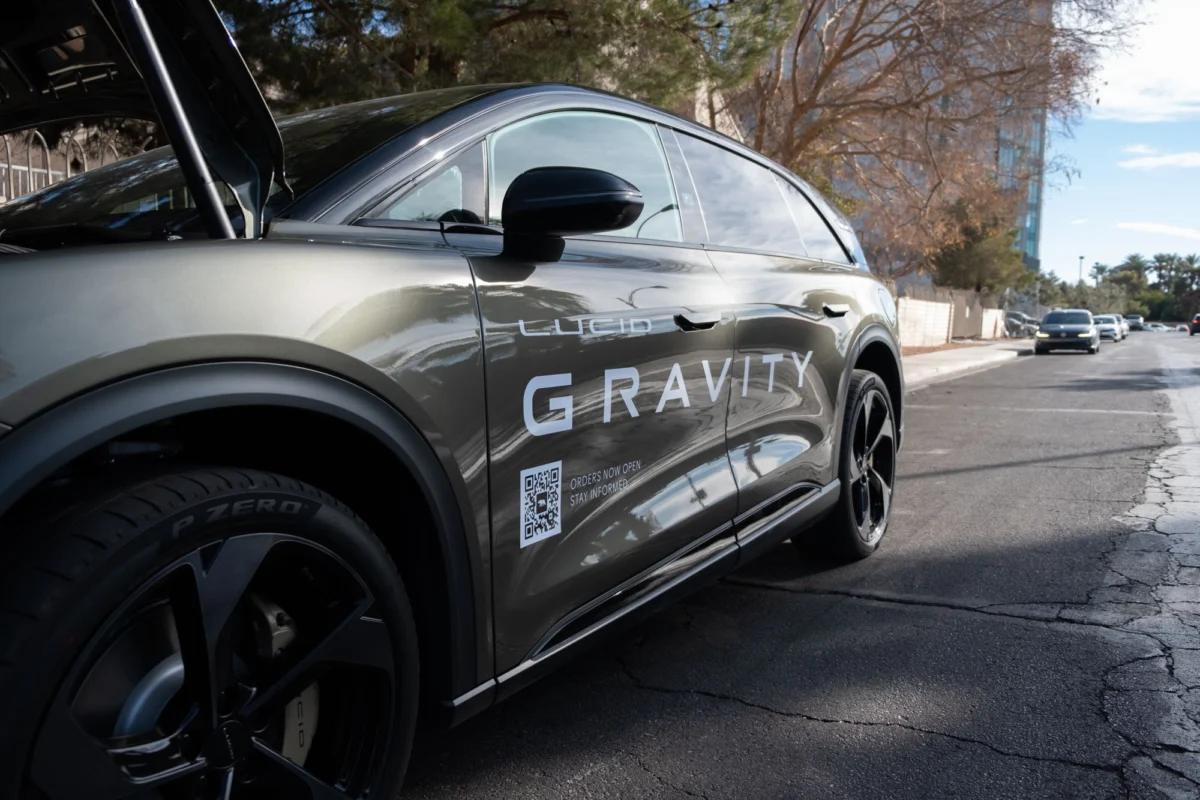
The primary commercial vehicle for this technology is a high-profile partnership with ride-hailing giant Uber and autonomous vehicle technology firm Nuro. The program integrates Nuro’s self-driving software suite into Lucid’s premium Gravity SUVs, with Uber managing the customer-facing ride-hailing network.
According to Napoli, this business model represents a highly lucrative opportunity that bypasses the low-margin bottlenecks of traditional automotive retail:
"We project the margins vastly exceeding those of the traditional retail model."
Currently, Nuro and Uber are testing a pilot fleet of 100 autonomous Gravity vehicles in San Francisco and Houston. In July, Lucid began delivering production validation vehicles assembled at its specialized facility in Coolidge, Arizona. If development remains on schedule, regular vehicle production for the robotaxi program will begin in the fourth quarter of 2026, targeting a commercial launch in late 2026.
The Mid-Sized ‘Cosmos’ Platform and Saudi Expansion
Despite the emphasis on autonomous fleets, Lucid is not abandoning the consumer market. The company’s upcoming mid-sized platform, code-named Cosmos, is viewed as its primary weapon to compete in the high-volume, mainstream EV segment. Napoli reaffirmed that the Cosmos platform remains an "essential element" of the company’s path to self-sustaining profitability.
Simultaneously, completing the construction of its AMP-2 manufacturing facility in Saudi Arabia remains a non-negotiable priority. Heavily backed by the Saudi Public Investment Fund (PIF)—Lucid’s majority shareholder—the AMP-2 facility is crucial for the company to tap into emerging Middle Eastern and European markets while fulfilling localized production commitments that are tied to its sovereign financial backing.
Ultimately, Lucid’s aggressive reset is a high-stakes race against time. By sacrificing near-term capital expenditure and streamlining its operations, the company is betting that its high-margin robotaxi software and upcoming mid-sized retail platform will arrive fast enough to secure its future before its $3 billion cash runway runs out in 2027.
