





Introduction
European cities are undergoing a dramatic architectural and demographic shift, and nowhere is this more visible than on their streets. The historic, narrow corridors of Rome, Paris, and Madrid—once dominated by nimble, iconic Italian "yoghurt pots" like the classic Fiat 500 or the Iso Isetta—are seeing a resurgence of ultra-compact transportation. Yet, the vehicles filling these spaces have changed fundamentally. The microcar segment, once a bastion of European industrial design, has largely been surrendered to Chinese manufacturing.
Even the icons of European urban mobility have migrated. Smart, the Mercedes-Benz-born pioneer of the modern ultracompact car, has transitioned into a joint venture with China’s Geely, moving its production lines far from the European continent. Today, cheap Chinese electric vehicles (EVs) dominate the entry-level microcar market.
Against this geopolitical and industrial backdrop, a Spanish startup named Liux is attempting to mount a defense. Armed with a novel linen-based biocomposite body, a lean manufacturing philosophy, and €16 million ($18.5 million) in funding, the Madrid-based company believes it can carve out a profitable, sustainable niche. Its weapon of choice? The "Liux Big"—a microcar whose ironic name belies the massive ambitions of its creators.
Main Facts: What is the Liux Big?
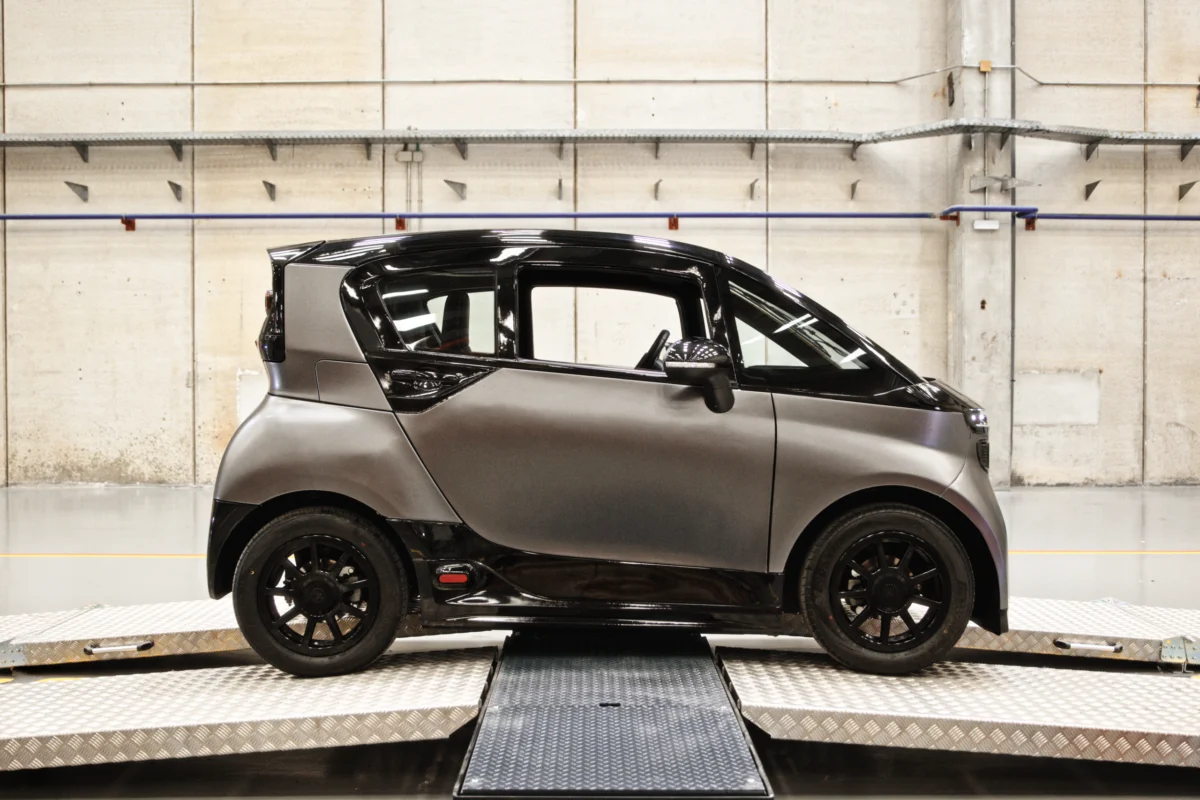
The Liux Big is a fully electric, two-seater microcar designed specifically for urban environments. Despite its name, the vehicle is small enough to be parked perpendicular to the curb, offering an elegant solution to the chronic parking shortages plaguing European metropolises.
Rather than competing directly on price with mass-produced, heavily subsidized Chinese imports, Liux is positioning the Big as a premium, deeply sustainable alternative.
Key Structural and Environmental Features
- Biocomposite Body: The vehicle’s outer shell and structural elements are constructed from a novel linen-based bio-fiber. This material is designed for true circularity, allowing the natural fibers to be extracted and recycled at the end of the vehicle’s lifecycle.
- Modular Battery System: While the battery cells themselves are sourced from outside Europe, the pack is designed to be easily accessible, modular, and rapidly replaceable. This mitigates the risk of early vehicle obsolescence driven by battery degradation.
- L7e Quadricycle Classification: The vehicle is homologated under the European Union’s L7e heavy quadricycle category. This allows the company to bypass some of the incredibly capital-intensive crash-testing and regulatory hurdles required for full-sized highway vehicles (M1 category), while still delivering a vehicle that drives like a traditional car.
- Target Price Point: Liux aims to retail the Big for under €18,000 (approximately $21,000 USD) before local electric vehicle subsidies are applied.
Chronology: From Hypercars to Micro-Mobility
The road to the Liux Big has been anything but linear. It represents the intersection of two distinct entrepreneurial paths: one rooted in social entrepreneurship and circular design, the other in high-performance automotive engineering.
[2017] David Sancho unveils Bóreas Hybrid Hypercar at Le Mans
  │
[2022] Antonio Espinosa de los Monteros & Sancho found Liux; unveil "The Animal" (5-seater EV)
  │
[2023-2024] Strategic Pivot: Team identifies homologation barriers; shifts focus to microcars (Geko/Big)
  │
[2026] Liux secures Europe-wide homologation for the "Liux Big"; expands to 65 employees across 3 Spanish plants
  │
[2027 (H1)] Expected commercial market launch of the Liux Big
2017: The Genesis of Performance
Before co-founding Liux, David Sancho was entrenched in the world of high-performance automotive design. His crowning engineering achievement came in 2017 when he unveiled the Bóreas—a hybrid hypercar boasting over 1,000 horsepower—at the prestigious 24 Hours of Le Mans. The project demonstrated Sancho’s capability to design lightweight, high-strength vehicular platforms. However, internal disputes led to Sancho parting ways with his partners, leaving him looking for a new automotive canvas.
2022: The Circularity Vision and "The Animal"
Sancho partnered with Antonio Espinosa de los Monteros, a prominent Spanish social entrepreneur. Monteros had previously co-founded Auara, a highly successful Spanish B Corp that funded clean water projects by selling mineral water in 100% recycled and recyclable plastic bottles. Following Auara’s acquisition by the beverage conglomerate Corporación Hijos de Rivera, Monteros sought to apply his rigid standards of "real circularity" to the heavily polluting automotive industry.

In late 2022, the duo unveiled their first prototype: the Liux Animal. The Animal was a sleek, fully electric, five-seater sedan constructed almost entirely from plant-based composites and recycled materials. It was designed to challenge Tesla.
2023–2024: The Strategic Pivot
While the Animal garnered significant media attention, the founders quickly confronted the harsh realities of automotive manufacturing. Homologating a full-sized M1 passenger vehicle in Europe requires hundreds of millions of euros in capital, rigorous destructive crash testing, and complex global supply chains.
Realizing that the barriers to entry were too high for a young startup, Monteros and Sancho made a critical pivot. They shelved the Animal and focused their engineering talent on a smaller, lighter platform—initially teased as the "Geko" and ultimately developed into the "Liux Big." The smaller footprint meant lower capital requirements, simplified European homologation pathways, and a faster route to market.
2026: Homologation and Production Readiness
By mid-2026, Liux successfully secured comprehensive Europe-wide homologation for the Liux Big. The company expanded its workforce to 65 employees and established three distinct manufacturing and assembly facilities across Spain, including its primary assembly hub in Azuqueca de Henares, located an hour outside of Madrid.
Supporting Data: Specifications, Capital, and Market Demand
As Liux prepares for its commercial launch in the first half of next year, the company’s business model is backed by key operational, financial, and technical metrics:
| Metric | Specification / Value |
|---|---|
| Funding Secured | €16 million (~$18.5 million USD), including private investment and EU public grants |
| Homologation Category | L7e (Heavy Quadricycle) |
| Target Retail Price | Under €18,000 (before EV subsidies) |
| Battery Capacities | 15 kWh and 20 kWh configurations |
| Trunk Capacity | 240 Liters |
| Current Waitlist | 7,500+ sign-ups (no-fee reservations) |
| Core Target Demographic | Urban residents aged 55 to 60 (purchasing as a household’s second vehicle) |
| Projected Production Capacity | Up to 20,000 vehicles per year by 2030 |
| Current Headcount | 65 employees across three Spanish sites |
Technical Innovation in the L7e Category
The L7e quadricycle category imposes strict regulatory weight limits (typically under 450 kg for passenger transport, excluding batteries). Most competitors in this space sacrifice structural rigidity, space, and safety to meet these targets.
Liux’s R&D department, led by industry veteran Celso Fernández, used advanced composite engineering to maximize the Big’s interior volume. By utilizing lightweight flax fibers instead of heavy steel body panels, they managed to integrate a highly competitive 240-liter trunk while maintaining a robust, crash-resistant passenger cell.
Official Responses: Perspectives from the Leadership Team
The executive team at Liux maintains a pragmatic, highly focused view of their position in the global EV market. They openly reject the conventional narrative of total European industrial independence, choosing instead to focus on smart localization and materials science.

On the Myth of the "European Car"
Antonio Espinosa de los Monteros, CEO and co-founder, is remarkably candid about the limitations of regional supply chains.
"The idea of a European car does not exist. A fully sovereign supply chain is unattainable in the current global market."
Rather than fighting an impossible battle to source every chip and battery cell within Europe, Monteros argues that true sustainability lies in how a car is put together—and how easily it can be taken apart.
"One thing that’s very clear for David [Sancho] and me is that recycling isn’t just a lab concept. You can recycle almost anything in a lab. What makes something recyclable has to do with how it’s built. When you build something, you have to try to preserve the integrity of the material and the components so that a second life is possible."
On Vehicle Dynamics and Safety
For Chief Engineer David Sancho, the priority was ensuring that the Liux Big did not drive like a fragile golf cart—a common complaint leveled against lightweight quadricycles.
"You don’t want a car that’s only lightweight because its frame can’t withstand a crash, or that will topple on the first turn."
Though the L7e classification does not legally mandate standard passenger-car crash testing, Sancho’s team has subjected the Big to rigorous dynamic testing, including high-speed slaloms and emergency braking maneuvers, to guarantee stability and passenger safety.
On Lean Manufacturing
Beatriz Belda, Head of Production and a veteran engineer who previously managed manufacturing processes for BMW in Munich, oversees the Azuqueca de Henares plant. She emphasizes that the factory’s small footprint is a deliberate asset, modeled after the Toyota Production System (TPS).

"Our factory is small because it follows lean management principles. We focus exclusively on the final assembly and quality control stages, which keeps overhead low and allows us to scale production efficiently toward our 20,000-unit annual target."
Implications: Can Liux Redefine Urban Mobility?
The success or failure of Liux will have broad implications for the European automotive industry as it struggles to defend its home turf against Chinese giants like BYD, Geely, and SAIC.
1. The Geopolitics of the EV Supply Chain
Liux’s strategy offers a potential blueprint for other European startups. By acknowledging that battery manufacturing remains concentrated in Asia, Liux avoids the capital trap of trying to build localized gigafactories. Instead, they focus their intellectual property on areas where Europe still holds a competitive edge: advanced materials science, design, and high-value localized assembly. If successful, this "semi-sovereign" model could protect European manufacturing jobs without requiring unrealistic supply-chain isolation.
2. Materials Science as a Decarbonization Pathway
The automotive industry’s current decarbonization strategy focuses almost entirely on tailpipe emissions. However, the manufacturing footprint (Scope 3 emissions) of steel, aluminum, and carbon fiber remains incredibly high.
Liux’s pioneering use of flax-based biocomposites proves that structural vehicle components can be grown agriculturally, absorbing carbon dioxide during their lifecycle, and safely returned to the earth or recycled afterward. If this material performs well in real-world urban conditions, it could spark wider adoption of bio-composites by larger automotive conglomerates.
3. The Reality of Microcar Ownership
While urban planners dream of microcars replacing full-sized SUVs entirely, Liux’s waitlist data suggests a more conservative reality. With the primary buyer demographic being older, affluent urbanites purchasing the Big as a secondary vehicle, the microcar may not immediately eliminate traditional car ownership.
However, by offering a highly sustainable, easily parkable secondary vehicle, Liux could significantly reduce the physical and environmental footprint of suburban-to-urban commuting in Europe’s most congested historic centers.
