





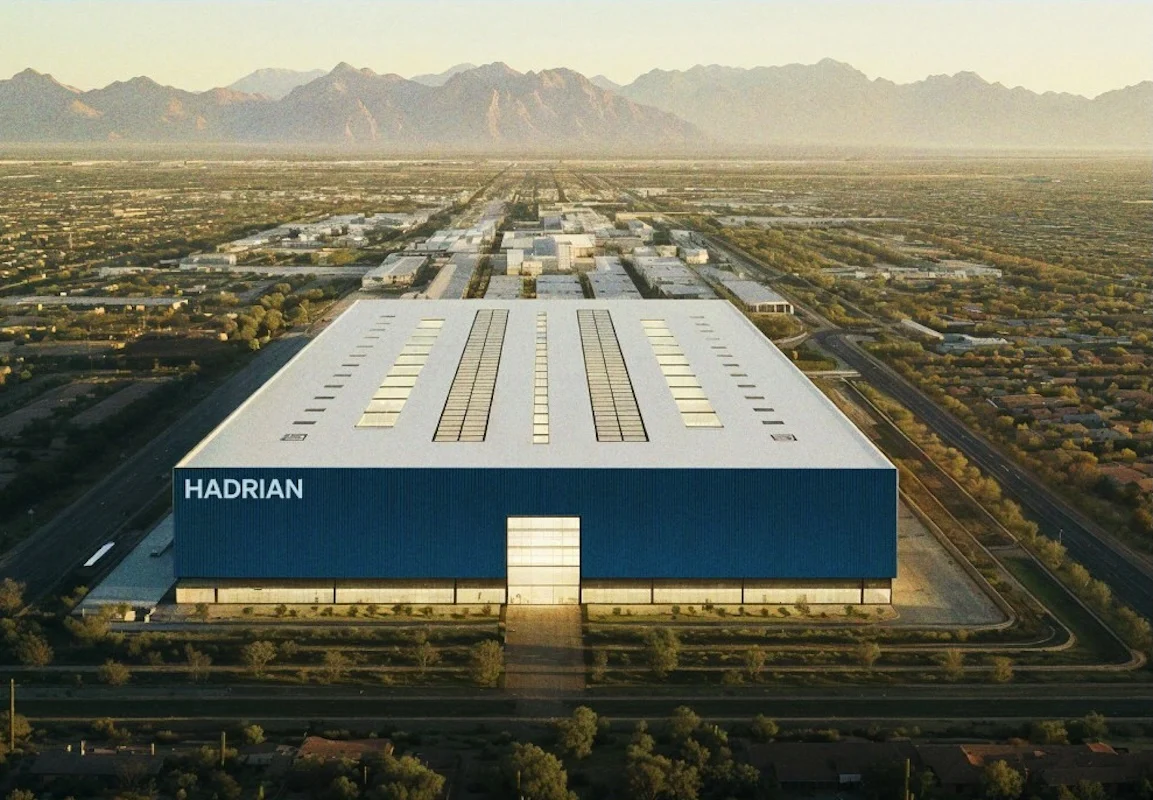
MESA, ARIZONA — In one of the largest private funding rounds in the defense technology sector to date, advanced manufacturing startup Hadrian has announced a massive $1.37 billion Series D investment round. The capital injection values the company at $7.87 billion, cementing its status as a critical player in the Pentagon’s efforts to modernize and secure the domestic supply chain.
Unlike many of its venture-backed peers in the defense sector that focus on autonomous drones, artificial intelligence software, or next-generation surveillance, Hadrian has taken a decidedly physical path. The company builds highly automated, software-driven precision manufacturing facilities designed to mass-produce the critical hardware components required for national security infrastructure—ranging from rocket engines to nuclear submarines.
The funding round reflects a growing consensus among Wall Street and Silicon Valley investors that the ultimate bottleneck in modern warfare is not software, but the physical capacity to manufacture complex hardware at scale.
Main Facts: Inside Hadrian’s Massive $1.37 Billion Capital Raise
The Series D round was supported by a diverse syndicate of institutional investors, growth equity firms, and defense-focused venture funds.
The Investor Syndicate
The financing was co-led by a coalition of prominent investment firms, including:
- WCM Investment Management
- Washington Harbour Partners
- Valor Equity Partners (known for its early backing of Tesla and SpaceX)
- 137 Ventures
- Baillie Gifford
A highly competitive roster of participating investors also joined the round, highlighting the broad-based financial backing for Hadrian’s industrial mission. These participants include:
- 1789 Capital
- Morgan Stanley Wealth Management
- Funds and accounts managed by Apollo Global Management and T. Rowe Price
- Alphabet’s growth fund, CapitalG
- Andreessen Horowitz (a16z)
- Founders Fund
- Lux Capital
- Altimeter Capital
This capital influx brings Hadrian’s total funding raised to date to approximately $2 billion, according to PitchBook estimates. The $7.87 billion valuation places the company in the top tier of defense technology unicorns, alongside industry pioneers like Anduril Industries and Palantir Technologies.
The Core Mission: Software-Defined Metal
At its core, Hadrian operates as a high-tech prime contractor for precision-machined parts. Traditional defense manufacturing relies on a fragmented ecosystem of thousands of legacy, family-owned machine shops across the United States. Many of these shops suffer from aging workforces, manual workflows, and severe backlogs, leading to lead times that can span several months for basic components.
Hadrian solves this bottleneck by building highly automated factories that run on proprietary software. By automating the design-to-manufacturing pipeline, Hadrian can produce space- and military-grade components in days rather than months. Its factories utilize advanced multi-axis CNC machines integrated with robotic loading systems and AI-driven quality control, allowing the company to operate continuously with minimal human intervention.
Chronology: The Rapid Rise of an Industrial Giant
Hadrian’s trajectory from a stealth startup to a multi-billion-dollar defense asset has been remarkably swift, driven by acute geopolitical pressures and a chronic shortage of domestic manufacturing capacity.
[2020-2021] Hadrian Founded; initial seed and Series A rounds secure early manufacturing footprint.
     │
[Mid-2025]  Series C Funding: Raises $260 million led by Founders Fund and Lux Capital.
     │
[March 2026] Alabama Facility Launch: Establishes 4th facility via $2.4B public-private partnership.
     │
[August 2026] Series D Funding: Secures $1.37 billion at a $7.87 billion valuation.- Founding and Early Growth (2020–2024): Hadrian was founded with the thesis that the US defense industrial base was fragile and unable to support a protracted, high-intensity conflict. The company focused its early efforts on perfecting its software platform, which automates the programming of CNC machines, drastically reducing the time required to set up a production run.
- The Series C Inflection (Mid-2025): Approximately one year ago, Hadrian raised a $260 million Series C funding round led by Founders Fund and Lux Capital. This round allowed the company to expand its footprint beyond its initial facilities in the Southwest, validate its AI-powered factory operating system, and transition from manufacturing individual components to full-product assembly.
- The Submarine Breakthrough (March 2026): In a major validation of its operational model, Hadrian announced the opening of its fourth manufacturing facility, located in Alabama. Structured as a massive $2.4 billion public-private partnership, the facility was built specifically to support the production of the U.S. Navy’s Columbia-class and Virginia-class submarine programs.
- The Series D Mega-Round (August 2026): Armed with proof-of-concept from its Alabama and Arizona facilities, Hadrian secured its $1.37 billion Series D to fund the construction of "Factory 3" in Mesa, Arizona, and to scale its automated manufacturing blueprint globally.
Supporting Data: The Industrial Bottleneck by the Numbers
To understand why investors are willing to valued a manufacturing company at nearly $8 billion, one must look at the structural deficits currently plaguing the United States defense supply chain.
The Submarine Crisis
The U.S. Navy’s submarine industrial base is currently facing its most severe backlog in decades. The Pentagon aims to build one Columbia-class ballistic missile submarine and two Virginia-class fast-attack submarines per year. However, due to a shortage of skilled labor and precision parts, the supply chain has consistently fallen short of this "1+2" production rate.
| Metric / Program component | Traditional Machine Shop Ecosystem | Hadrian Automated Facility |
|---|---|---|
| Average Part Lead Time | 12 to 26 weeks | 1 to 3 weeks |
| Programming Setup Time | Days of manual CNC coding | Minutes (AI-assisted automated CAM) |
| Labor Utilization | Limited to 8-hour operator shifts | 24/7 "lights-out" robotic operations |
| Quality Control Yield | Variable (highly dependent on machinist skill) | Automated, high-fidelity optical inspection |
The $2.4 billion public-private partnership in Alabama was designed specifically to address this shortfall. By automating the production of complex structural and fluid-system components for nuclear submarines, Hadrian aims to compress supply chain timelines by up to 80%.
Capital Efficiency and Scale
Hadrian’s $2 billion in total funding represents a massive capital commitment, but it aligns with the capital-intensive nature of heavy industrial manufacturing. Unlike software companies, Hadrian’s growth requires significant capital expenditures (CapEx) to purchase advanced machine tools, secure industrial real estate, and build out robust power and cooling infrastructure.
However, the returns are defended by long-term government contracts and high barriers to entry. The defense precision parts market in the U.S. alone is estimated to be worth over $40 billion annually, with the broader aerospace and defense manufacturing sector exceeding $150 billion.

Official Responses: Strategic Perspectives from Leadership and Investors
In statements accompanying the funding announcement, Hadrian’s leadership and its primary backers framed the investment not just as a commercial venture, but as a vital national security imperative.
In its official press release, Hadrian emphasized the strategic goal of the funding:
"America’s industrial base has been hollowed out over the last forty years, leaving our nation vulnerable to supply chain disruptions and manufacturing bottlenecks in a time of heightened global tension. This $1.37 billion Series D will allow us to accelerate America’s industrial renewal, building the highly automated, software-defined factories required to keep our country and our allies safe."
Spokespeople from the lead investment groups echoed this sentiment, pointing to the critical operational improvements Hadrian brings to the table. A representative from Valor Equity Partners commented on the firm’s decision to co-lead the round:
"We have spent decades investing in companies that scale advanced physical infrastructure through software. Hadrian is applying this exact methodology to the most critical sector of all: national defense. Their ability to deliver precision parts at a fraction of the legacy cost and lead time is a game-changer for the defense industrial base."
An official from Lux Capital, which co-led the previous Series C, remarked on the company’s rapid execution:
"When we doubled down on Hadrian last year, we knew the demand was there. But the speed at which they have scaled—exemplified by their multi-billion-dollar submarine manufacturing partnership in Alabama—has surpassed expectations. They are proving that automated manufacturing is not just a concept; it is actively keeping our critical defense programs on track."
Implications: Re-Shoring, Sovereign Capability, and the Future of Defense
The successful scaling of Hadrian has profound implications for the geopolitics of defense, the structure of the military-industrial complex, and the broader venture capital landscape.
1. Breaking the Dependency on Foreign Supply Chains
Decades of offshoring have left the U.S. defense supply chain quietly dependent on foreign manufacturers, including adversaries, for raw materials, casting, forging, and micro-components. By establishing highly automated, economically competitive factories domestically, Hadrian provides a viable path toward complete supply chain sovereignty. Automated manufacturing offsets the higher labor costs associated with domestic production, making "Made in America" not just a patriotic sentiment, but an economically superior option.
2. Shift in Defense Procurement: Software Primes vs. Legacy Giants
For decades, the Department of Defense (DoD) relied exclusively on traditional prime contractors—such as Lockheed Martin, General Dynamics, and Northrop Grumman—to manage entire programs. However, these legacy primes rely on a fragile network of tier-2 and tier-3 sub-tier suppliers.
Hadrian represents a new category of "industrial utility." By acting as a shared, highly efficient manufacturing substrate, Hadrian can supply precision components to legacy primes, newer defense-tech disruptors (like Anduril, Apex, or Varda), and government agencies alike. This democratizes access to high-quality manufacturing, enabling faster iteration and competition across the entire defense sector.
3. The "Lights-Out" Factory as a Standard
Hadrian’s success validates the concept of the "lights-out" factory—manufacturing environments that can run completely unattended overnight. By leveraging artificial intelligence to automate the complex math required to program multi-axis CNC machines, Hadrian is mitigating the acute shortage of skilled machinists in the United States. As the average age of the American machinist continues to rise, software-driven automation will transition from a competitive advantage to an absolute necessity.
4. A New Class of Venture-Backed Defense Giants
The sheer size of Hadrian’s Series D demonstrates that venture capital’s appetite for hard-tech and defense investments has reached unprecedented levels. Historically, VCs shied away from capital-intensive businesses with long government sales cycles. Today, the urgent need for national security resilience has created a market where capital-intensive hardware startups can achieve multi-billion-dollar valuations and secure massive, long-term government commitments.
As Hadrian begins construction on its third major facility in Mesa, Arizona, the company is not just building a business—it is constructing a blueprint for the future of American industrial power.
